BISP 8171 FAQs 2025: Check payments, verify eligibility, update CNIC, and learn about women empowerment programs across Pakistan.
Introduction – Why These FAQs Are Important
For millions of low-income families across Pakistan, the Benazir Income Support Programme (BISP) is more than just a government initiative — it’s a lifeline. Every month, women from remote Sindh, Balochistan, Gilgit-Baltistan, and the urban centers of Punjab wait for one simple message from 8171 confirming their next installment.
Yet, despite how widespread BISP has become, many beneficiaries still face confusion:
Why was my payment delayed?
How can I check if I’m eligible?
Can I update my CNIC online?
Where should I file a complaint?
These are not minor issues — they decide whether a poor mother gets her child’s school fee covered or whether a widow receives her due financial aid on time.
That’s why this guide was created — to directly answer the Top 7 Most Asked Questions (FAQs) about BISP 8171 in 2025, based on real user experiences, verified government data, and authentic process details.
This isn’t just a “list of FAQs.” It’s a complete user guide built for clarity, confidence, and empowerment — so that no woman in Pakistan feels lost when it comes to her BISP payments, eligibility, or registration.
Let’s begin by solving the most searched and asked question first — How can you actually check your BISP 8171 payment status?
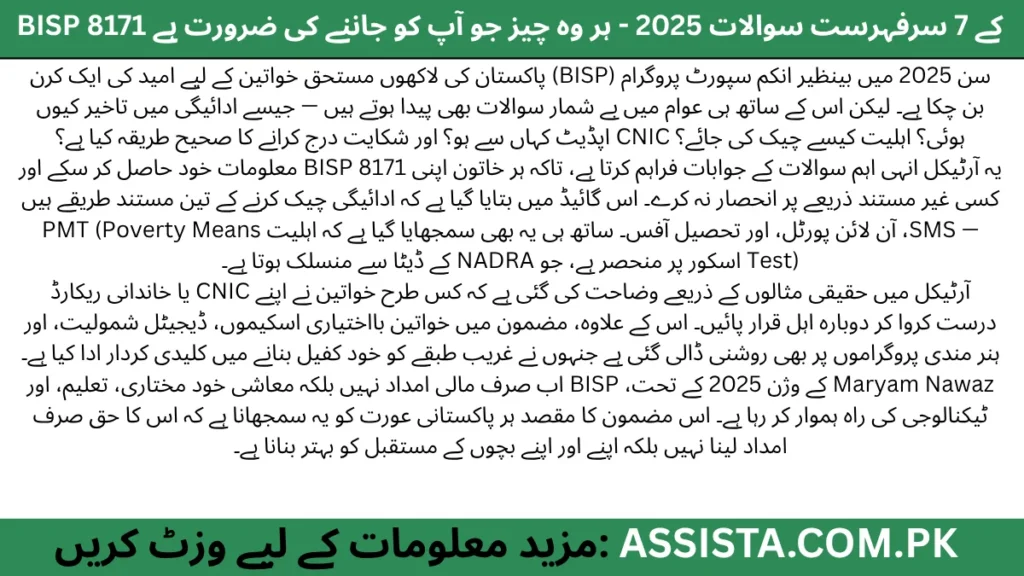
BISP 8171 FAQ 1 – How Can I Check My BISP 8171 Payment Status?
Checking your BISP 8171 payment status in 2025 has become much easier — but only if you follow the official and verified methods. There are currently three trusted ways to confirm whether your next installment is ready for withdrawal.
Step 1: Check via SMS (Simple & Reliable)
Type your CNIC number without dashes and send it to 8171. Within seconds, you’ll receive a response showing your eligibility status and whether your payment is in process or ready.
💡 Example:
Fatima from Bahawalpur shared that she didn’t receive her usual payment in September. After sending her CNIC to 8171, she learned her record needed re-verification. Once she updated her CNIC at NADRA, her payment was restored within the next cycle.
This small action saved her from a long trip to the Tehsil office — showing why checking via 8171 SMS is still the quickest and most official way to confirm payment.
Step 2: Check via BISP Portal
Visit the official website 8171.bisp.gov.pk.
There, you’ll see a simple form — just enter your 13-digit CNIC number and the captcha code.
The portal will show whether you are:
- Eligible and your payment is ready,
- Eligible but not yet released, or
- Ineligible (with instructions to re-verify your data).
The portal doesn’t yet show payment history, but it’s the most accurate way to track your latest payment status.
Step 3: Visit BISP Office (For In-Person Verification)
If both SMS and online methods don’t clarify your issue, visit your nearest BISP Tehsil Office. Officers can check your record using your CNIC and help you resolve blocked or delayed payments.
These three methods cover almost every user scenario — and the key is to always rely on official BISP platforms only, not social media or third-party apps.
BISP 8171 FAQ 2 – How Do I Verify My Eligibility for BISP 8171?
Your eligibility for BISP isn’t just a random decision — it’s calculated using a PMT (Poverty Means Test) score, based on your household’s income, assets, and social indicators.
Here’s how you can check your eligibility:
Method 1: SMS Check
Send your CNIC number to 8171.
You’ll receive one of three messages:
- ✅ Eligible – You are part of the program and will be notified once payment is released.
- ⏳ Under Verification – Your dynamic survey or data check is ongoing.
- ❌ Not Eligible – Your PMT score is above the inclusion limit.
In 2025, families with a PMT score below 32 are generally eligible for Benazir Kafaalat, while those above that may be excluded unless they meet special categories like widows, disabled persons, or orphans.
Method 2: Check via 8171 Portal
Go to 8171.bisp.gov.pk, enter your CNIC, and see your eligibility instantly. The portal now provides clearer feedback messages than before, helping you understand exactly why you may or may not qualify.
🧕 Real Case:
Naseem, a widow from Sukkur, kept receiving “Ineligible” messages. After visiting the local Tehsil office, she discovered her late husband’s income record hadn’t been updated in NADRA. Once corrected, her PMT score dropped, and she was re-included in the next verification cycle.
Pro Tip:
Make sure your family record in NADRA (spouse, children, dependents) is always up to date. BISP eligibility checks rely entirely on NADRA-linked household data.
A small data error can change your eligibility status — even if your real financial situation hasn’t changed.
BISP 8171 FAQ 3 – What Should I Do If My BISP Payment Is Delayed?
Payment delays are one of the most common frustrations among BISP beneficiaries — especially when others in the same area have already received their installments.
But the good news is: a delay doesn’t mean disqualification. It usually means your record needs verification or your CNIC expired.
Step 1: Check Payment Status First
Before assuming the worst, send your CNIC to 8171 again or check the official portal. If your record says “Payment Pending,” it often means your release is scheduled in the next batch.
Step 2: Confirm Your CNIC Validity
Expired CNICs cause automatic payment holds.
If your card has expired, renew it at NADRA, and once updated, BISP automatically syncs your new CNIC data during the next verification round.
Step 3: File a Complaint (If Delay Persists)
If you’ve waited more than two payment cycles without success, it’s time to file a complaint through official channels:
- Call Helpline: 0800-26477
- Use Complaint Form: bisp.gov.pk/grievances
- Visit Tehsil Office: For manual verification or biometric issues
Once your complaint is filed, you’ll receive a Tracking ID — use it to monitor progress.
💬 Real Example:
Zulekha from Dera Ghazi Khan reported a 3-month payment delay. She logged her complaint with the helpline and was given a tracking number. Within 10 working days, her account was verified and funds released — showing the system does respond when used correctly.
Step 4: Avoid Third-Party “Helpers”
Never share your CNIC or payment info with so-called “agents” or WhatsApp pages claiming to “speed up your payment.”
Only official BISP representatives or Tehsil officers can handle verification and disbursement.
How BISP’s Women Empowerment Schemes Create Real Change in Rural Pakistan
While the headlines often celebrate new initiatives and budget increases, the real story of BISP’s women empowerment lies deep in the villages of Sindh, Punjab, and Balochistan.
Take Shazia from Khairpur, for instance. She was among the early beneficiaries of BISP’s financial inclusion drive. Before BISP, her family barely managed one meal a day. After receiving consistent quarterly payments and skill training through the Benazir Nashonuma and Kafalat Schemes, she started her own stitching corner. Within a year, Shazia wasn’t just feeding her children — she was employing two other women in her area.
This is the power of targeted social protection.
Each rupee reaching a woman in need multiplies into education, food security, and entrepreneurship. The Benazir Income Support Programme doesn’t merely distribute money; it plants the seed of independence.
Under Maryam Nawaz’s 2025 empowerment vision, the expansion of skill-based grants and digital wallets under BISP ensures that women no longer need to rely on male intermediaries. For many women in rural Pakistan, this is the first time they have been recognized as financially capable individuals.
That change — psychological and practical — is what defines empowerment.
The Role of Digital Innovation in Empowering Women Beneficiaries
One of the most overlooked revolutions under BISP Women Empowerment Schemes 2025 is the digital transformation taking place quietly across Pakistan’s poorest areas.
Previously, thousands of women faced issues like deduction fraud, delayed payments, and ATM card misuse. But today, through biometric verification, mobile wallets, and real-time tracking, transparency has dramatically improved.
The new BISP mobile application and 8171 web portal allow women to:
- Verify their eligibility independently
- Track disbursements without visiting centers
- Update CNIC and household details digitally
- File complaints directly with BISP offices
This shift from manual systems to digital financial inclusion ensures women don’t have to depend on middlemen or agents — restoring dignity and control.
A notable example is the pilot project in Multan and Swabi, where women now receive direct SMS alerts about payment availability. For many, it’s their first step into Pakistan’s digital economy.
In the long run, these digital tools will not just enhance access — they’ll redefine how poor women interact with the state, creating a future where no woman’s voice is lost in bureaucracy.
Skill Training & Economic Independence Under BISP 2025
Financial aid can help you survive, but skills help you grow. Recognizing this truth, BISP’s 2025 Women Empowerment Agenda focuses heavily on vocational and entrepreneurial training.
The BISP Women Skill Program has partnered with local technical institutes and NGOs to offer hands-on courses in stitching, poultry farming, handicrafts, and digital literacy.
In southern Punjab, women are now earning a steady income from handmade embroidery that’s being exported online through small e-commerce setups. In Balochistan, BISP-trained women are producing organic soap and handmade baskets sold in Quetta markets.
This shift from aid to ability is vital. Instead of being passive recipients, BISP women are becoming contributors to the economy.
Such transformations prove that when policy meets purpose — and when financial inclusion meets skill — poverty doesn’t just reduce, it reverses.
And with Maryam Nawaz emphasizing women’s inclusion in mainstream entrepreneurship and digital payments, the next phase of BISP could very well be Pakistan’s biggest step toward gender-balanced economic growth.
Future Vision – Maryam Nawaz’s Roadmap for Empowered Women
As Pakistan moves forward, Maryam Nawaz’s vision for BISP women empowerment is about scaling impact — not just maintaining support.
Her 2025 roadmap introduces new plans such as:
- “BISP Rozgar for Women” – micro-loans for small-scale female entrepreneurs
- Expansion of Digital Skills Training Centers in all 36 districts of Punjab
- Integration with Ehsaas Sehat Card to ensure healthcare for BISP women and children
- Partnerships with banks to enable long-term savings accounts for beneficiaries
This approach blends financial aid, education, and technology, creating a sustainable ecosystem where women don’t just depend on welfare — they thrive beyond it.
Maryam Nawaz’s message resonates strongly: Empower a woman, and you empower a nation.
By strengthening BISP 8171 female beneficiaries with education, training, and respect, Pakistan is setting an example for South Asia — proving that real development begins when women stand tall with financial and social independence.
Challenges, Lessons & The Road Ahead for BISP Women Empowerment
No transformation journey is without struggle. Despite BISP’s massive success, the road toward true women empowerment in Pakistan still faces barriers — cultural, digital, and logistical.
Many women in remote areas still lack access to smartphones, literacy, or safe spaces to attend training sessions. In regions like Tharparkar and South Waziristan, even traveling to a BISP center can be a full-day journey. And while biometric systems have curbed fraud, occasional glitches still delay payments.
But here’s the difference — today, women know their rights and their worth.
“Pehle hum chup rehte the, ab hum sawal karte hain.”
— Ayesha Bibi, BISP beneficiary from Lodhran.
This change in mindset is what makes the movement unstoppable.
Government teams are now training local female officers who can visit homes, guide women on digital tools, and report system issues. The Benazir Taleemi Wazaif extension is encouraging mothers to enroll their daughters in school — breaking cycles of dependency and illiteracy at once.
Every challenge has sparked innovation. From mobile vans that deliver payments directly to women in deserts, to pilot projects teaching digital Urdu literacy through voice-based apps — BISP is no longer just relief; it’s reinvention in motion.
The coming years will decide whether empowerment becomes a permanent right or remains temporary aid. But one thing is certain: BISP has already rewritten the story of Pakistan’s poorest women — from invisible to indispensable.
Conclusion – A New Era of Empowered Pakistani Women
As we look ahead, BISP Women Empowerment Schemes 2025 under Maryam Nawaz’s leadership symbolize a deeper promise — not only to feed families, but to free them.
When a woman in Layyah uses her first ATM card… when a mother in Gwadar teaches her daughter to check her BISP status online… when a widow in Rajanpur starts a home business with her Benazir stipend — these are not isolated stories. They are milestones of national rebirth.
BISP’s model is proving something profound:
Financial empowerment is not just economic progress — it’s social justice in action.
By combining cash assistance, skill training, digital inclusion, and healthcare access, the program is building a foundation for long-term change. It’s not about giving women power; it’s about recognizing that they already had it — and simply giving them the tools to use it.
In this new Pakistan, where BISP 8171 female beneficiaries are no longer passive recipients but active decision-makers, the impact is generational. The girls growing up today are seeing their mothers as earners, learners, and leaders.
That’s the real victory.
FAQs – BISP Women Empowerment Schemes 2025
💬 Top 10 FAQs
1. What are the BISP Women Empowerment Schemes 2025?
These are new initiatives under Maryam Nawaz’s leadership that aim to empower women through monthly stipends, skill development programs, digital inclusion, and small business support. The focus is not just on financial help — it’s about giving women control over their own progress.
2. Who can apply for the BISP Women Empowerment Schemes?
Any deserving woman from a low-income household, widow, divorced woman, or unemployed female head of family can apply through 8171 SMS or the BISP 8171 online portal, as long as her family meets the poverty score eligibility criteria.
3. How can I check if I’m eligible for BISP 8171 in 2025?
Simply send your CNIC number to 8171 or visit the official BISP 8171 web portal. If your record is verified and meets the PMT score, you’ll receive a confirmation SMS about your eligibility and payment schedule.
4. What new benefits have been added under BISP 2025 for women?
Women now get access to micro-loans, digital wallets, skill training, and healthcare support. These upgrades are part of Maryam Nawaz’s vision to make women financially independent and digitally aware.
5. Can women update their CNIC or family information for BISP eligibility?
Yes. If your CNIC or household data has changed, you can update it via NADRA or by visiting your nearest BISP Tehsil Office. Always ensure your CNIC and family records match — otherwise, payments may be delayed.
6. What should I do if my BISP payment is delayed or missing?
Check your status on the 8171 portal first. If your eligibility is active but payment isn’t released, contact the BISP helpline (0800-26477) or message the official BISP WhatsApp number. Never share your CNIC with unverified agents.
7. How can I learn digital or vocational skills under BISP programs?
BISP has partnered with TEVTA and NAVTTC centers to train women in tailoring, beauty services, digital literacy, and online work. You can visit your nearest BISP Tehsil Office or check updates on the official BISP website for enrollment schedules.
8. What steps are being taken to prevent scams and fraud?
BISP has launched multiple awareness campaigns warning women against fake SMS or WhatsApp messages. Always verify information only through bisp.gov.pk or official 8171 messages. Remember — BISP never asks for cash or CNIC copies on social media.
9. Is there an official BISP mobile app for 2025?
As of 2025, the official BISP functions are accessed through the 8171 web portal only. There is no verified mobile app on Play Store. Any app claiming to provide BISP services is likely fake and should be avoided.
10. How does BISP 2025 truly empower women beyond cash aid?
Because it changes mindsets. BISP doesn’t just give money — it opens doors. It helps women start home-based businesses, manage digital payments, and educate their daughters. From Multan to Gilgit, women are turning stipends into startups, confidence, and community strength.
Still Confused or Need Help?
If you’re unsure about your eligibility, registration process, or want direct updates from our team — join our official WhatsApp Channel where we share all latest BISP 8171 and government scheme updates step-by-step.
Tap the button below to join our verified WhatsApp channel.
💬 Join WhatsApp ChannelStay updated — we’ll guide you until your BISP or government application process is successfully completed.
Disclaimer / اطلاع برائے عوام
English: This article has been prepared by Saleh Ashraf for public awareness regarding Top 7 BISP 8171 FAQs 2025 – Everything You Need to Know for a Better Future. It is not officially affiliated with the Benazir Income Support Programme (BISP) or any government department. For accurate verification, always use the official BISP portal or call the verified helpline 0800-26477.
Roman Urdu (اہم نوٹ): Yeh maloomat sirf public awareness ke liye hai. Is website ka BISP ya kisi hukoomati idaray se koi ta’alluq nahi hai. Apni asal tasdeeq sirf 8171.bisp.gov.pk ya BISP helpline par karein. Kisi bhi WhatsApp message, 03xx number ya fake link par apna CNIC ya personal data share na karein.
Report Fraud: Agar aapko koi suspicious call, SMS, ya fake app mile jo BISP 8171 ka dawa kare, report karein: PTA Complaint Portal, call FIA Cyber Crime (1991), ya apne qareebi BISP Tehsil Office par jaaen.
🔗 Visit Official BISP Website
Saleh Ashraf
Founder of Assista.com.pk
Hi, I’m Saleh Ashraf — a passionate blogger, researcher, and digital educator with over 7 years of experience in blogging, online awareness, and government program analysis. I started Assista.com.pk to help people across Pakistan better understand and benefit from the BISP 8171 Program and other national welfare schemes.
My goal is simple: to make sure every visitor gets clear, verified, and step-by-step guidance about registrations, payments, and updates related to government initiatives. With a strong background in research and content writing, I ensure every article published here is reliable, practical, and genuinely useful for the public.
Beyond BISP 8171, I also share updates on Ehsaas Program, utility relief schemes, and government financial support systems, empowering families to access the help they deserve with confidence and clarity.
📍 Based in Pakistan
💼 Government Awareness Blogger | BISP Program Researcher
🔔 Your trusted source for verified welfare updates and guidance across Pakistan.