I’ve tracked multiple BISP payment cycles — here’s exactly how the 8171 cash system works, why payments are phased, and how to check your real balance safely in 2025.
Last updated: May 2026
8171 Payment Check 2025 – How I Explain the BISP Cash System
In my experience tracking the BISP 8171 system over multiple payment cycles, I’ve noticed one thing very clearly: most users don’t struggle with eligibility — they struggle with understanding how payments actually move through the system.
The confusion usually starts when people see terms like installment schedule, phase payments, 8171 payment alerts, 13500 cash assistance, or balance check via CNIC — and no one explains what connects them.
But in reality, the BISP payment system is not random. It follows a structured release cycle based on verified eligibility, district‑level disbursement phases, and biometric verification at the point of collection. In this guide, I’ll break down how the payment system actually works in 2025, what I’ve observed from real user cases, and how you can safely track your payment status without falling for misinformation or fake “payment confirmation” messages.
🧠 How I Verify BISP 8171 Payment Information (My Method)
Before I explain anything about payment cycles, I follow a simple verification approach based on repeated system behavior and publicly available updates. I don’t rely on rumors, social media claims, or forwarded WhatsApp messages. Instead, I cross-check:
- Official 8171 portal behavior during live cycles
- Repeated patterns in district‑level payment announcements
- NSER eligibility flow consistency across different users
- Biometric verification outcomes at cash centers
- Timing differences across phases (Phase 1, Phase 2, etc.)
Over time, this method has helped me filter out misinformation and focus only on what consistently happens inside the system — not what people assume happens. This is important because BISP payments are not announced in one universal pattern; they behave like a rolling system, which changes slightly in every cycle but follows the same structural logic.
⚡ Quick Payment Facts (What the System Actually Does)
- Payments are only released to eligible NSER‑verified beneficiaries
- The system is fully biometric‑based at the withdrawal stage
- Payment status updates are linked directly with the 8171 portal
- Installments are released in phases, not all at once
- There is no fee for checking or receiving payments — ever
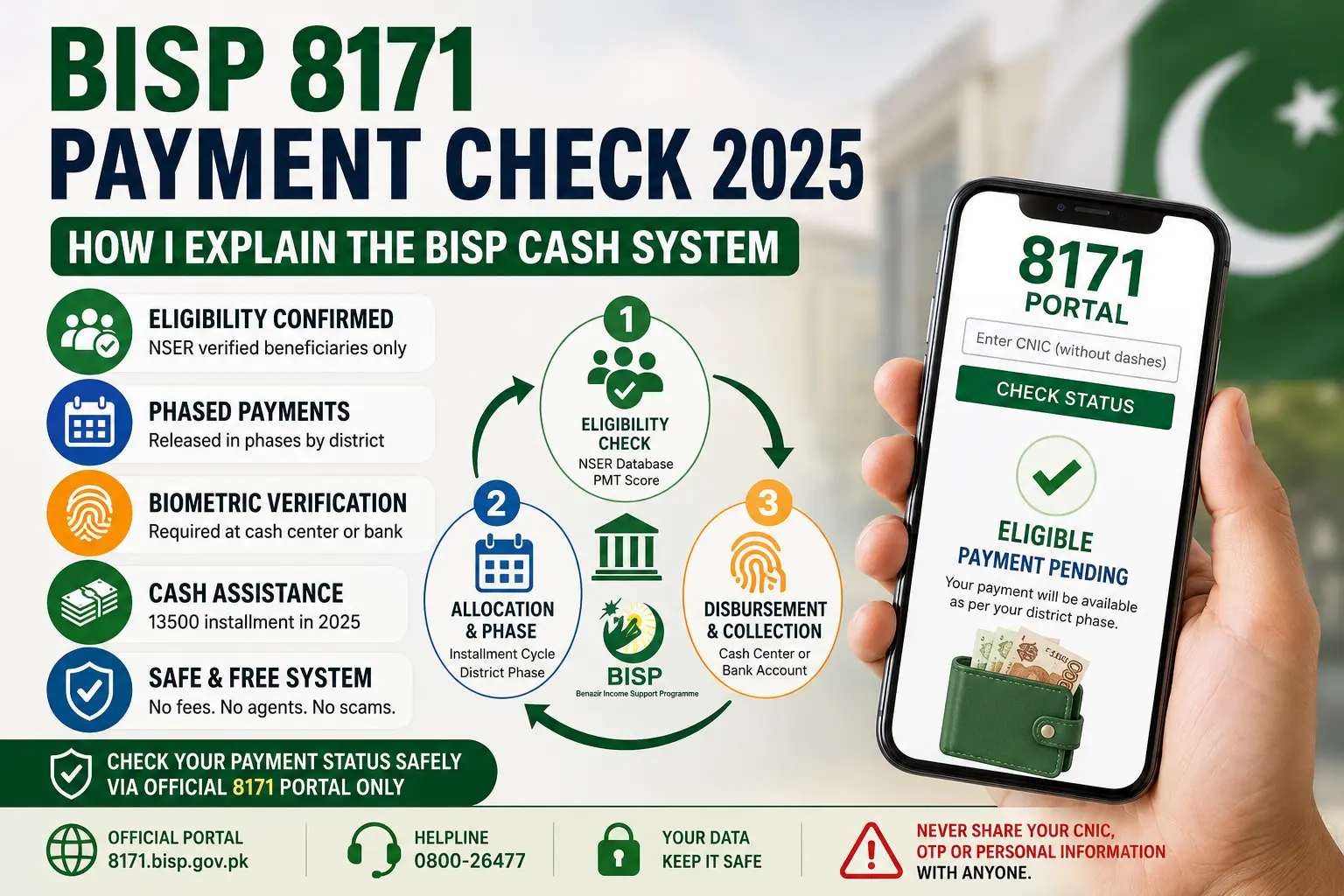
From Eligibility to Cash in Hand – The 3‑Layer Payment System I Observe
When I look at how the BISP payment engine operates, I don’t see a single “send money” button. I see three distinct layers that must all align before you can collect a single rupee.
Layer 1: Eligibility Confirmation (NSER Database)
Before any payment is generated, the system first confirms:
- Household eligibility in the NSER database
- PMT score status meeting the current threshold
- Active beneficiary record with no blocks or freezes
If this layer fails, no payment is created at all. That’s why I always tell users to confirm their CNIC status first — the payment pillar depends completely on the eligibility pillar. (I’ve covered CNIC verification in depth here.)
Layer 2: Payment Allocation & Phasing
Once eligibility is confirmed, the system assigns:
- An installment cycle (quarterly release)
- A phase (Phase 1, Phase 2, etc.) based on district
- District‑wise distribution timing
This is why some users receive money earlier than others — it’s not random, it’s phased distribution logic. The full payment schedule for 2025 shows how districts roll out, and I keep an installment schedule reference updated as each cycle is announced. If you’re wondering about the 13500 installment specifically, I’ve documented everything known about that amount here.
Layer 3: Disbursement & Collection
This is the final step where money actually reaches you. In 2025, I’ve observed two main collection channels:
- Designated BISP cash centers – biometric verification, then cash handover
- Partner bank accounts – where supported, payments are deposited directly
The full list of cash centers can be found in my separate guide: BISP cash centers list 2025. And for those whose payments are routed through bank accounts, I break down exactly how that method works: BISP bank payment method.
Regardless of method, the core rule never changes: no biometric match = no payment release.
📊 What I’ve Observed in Real Payment Cycles (2025 Pattern)
Based on multiple 8171 payment cycles I’ve tracked, I’ve noticed a consistent pattern that most users don’t realize.
1. Payments do NOT release nationally at once
Instead, the system activates district groups in waves. This means one district may receive payments today, another may receive them after several days, and some districts may temporarily show “pending” even when funds are already approved.
2. Portal status updates lag behind actual release
In many cases I’ve seen, the payment is already available at the cash center but the 8171 portal still shows “under process.” This happens because the backend financial release and portal update systems are not always synchronized in real time.
3. Biometric load affects “availability perception”
During peak days, cash centers get overloaded, biometric machines delay verification, and users think the payment is “not released” when it is actually active. So in most cases, delay perception is not a system delay.
Why Payment Status Isn’t Just “Paid” or “Not Paid”
From what I’ve observed, when you check your CNIC on the 8171 portal, the payment status usually reflects one of these backend‑driven states:
- Payment Released – money has been sent to the disbursement channel
- Under Process – eligibility is confirmed, but the phase hasn’t reached your district yet
- Not Eligible for Current Cycle – your PMT score didn’t meet the threshold this quarter
- Payment Pending Verification – your record is flagged for additional biometric or data review
- Blocked / Re‑verification Required – something in your NSER or biometric file triggered a freeze
Each status is tied directly to backend NSER + finance integration — it’s not a manual update. That’s why sometimes people see delays even after receiving an eligibility approval. The system is moving through its layers, and the status you see is a snapshot of where you are in that flow.
Why Payments Are Delayed or Split Into Phases (It’s Usually Not What You Think)
One of the most misunderstood parts of the system is timing. People often assume that if their neighbor got paid and they didn’t, something is wrong. But in my analysis of system updates, delays usually come down to:
- District‑level rollout scheduling – not all areas are released on the same day
- Server load during peak payment cycles – can delay status visibility, not the actual payment
- Biometric verification backlog – especially at crowded cash centers
- Re‑verification of updated NSER records – often triggered automatically
- Fraud prevention checks – a layer that can pause a payment silently
So when someone asks “why my neighbor got paid but I didn’t,” the answer is usually phase distribution sequencing, not rejection. The September 2025 payment breakdown and the Phase 2 payments update both illustrate exactly how staggered rollouts work in practice.
🧾 How I Interpret 8171 Payment Check Results (Don’t Misread These)
When a user shows me their status, I explain it using this simple mapping — because misreading “pending” as rejection is one of the most common mistakes I see.
| Status Shown | What It Actually Means | Your Action |
|---|---|---|
| Eligible + Paid | Payment released; ready for withdrawal via cash center or bank | Proceed with biometric collection |
| Eligible + Pending | System approved, but your phase hasn’t been released yet | Wait; check phase schedule for your district |
| Not Eligible | Your PMT score doesn’t meet the current cycle threshold | Understand registration options or re‑survey |
| Blocked | Biometric or NSER verification issue | Resolve via facilitation centre and re‑check |
This interpretation is critical because most users treat “pending” as a problem, when in fact it’s just a staging state in the phased release system.
⚠️ Common Payment Mistakes I See Users Make
From the behavior patterns I’ve tracked, most issues don’t come from the system — they come from these misunderstandings:
- Assuming an SMS is a payment guarantee (it’s a notification, not a confirmation)
- Trusting fake “balance check” websites that mimic the 8171 portal
- Going to unauthorized agents who claim they can release funds early
- Ignoring biometric update issues until the day of collection
- Not verifying the phase schedule for their specific district
These mistakes create confusion even when the system is working correctly. I’ve structured every guide I link to so that you can avoid exactly these traps.
👤 Real Scenario Example (How the System Actually Behaves)
Let me explain a real‑world type scenario I’ve repeatedly observed:
A user from District A checks their 8171 status and sees:
👉 “Eligible – Payment Pending”
At the same time:
- Another user in District B already collects cash
- The portal still shows “pending” for the District A user
After 2–5 days:
- District A becomes active
- The same user suddenly sees the payment available without any change in eligibility
What this shows:
- Eligibility does NOT change daily
- Payment activation is phase‑based
- Portal visibility is not always real‑time
This is why I always tell users not to panic based on a single‑day status check.
🔐 My Safety Observations (What I Always Warn Users About)
From what I’ve consistently observed, the biggest risk in the payment system is not delay — it’s misinformation.
I always advise:
- Never trust anyone offering “early payment release” — the system is automated, no external person can speed it up
- Never pay agents for withdrawal assistance — collection is free and biometric‑locked
- Never share your CNIC or OTP on WhatsApp or any messaging platform
- Always verify payment status through the official 8171 system only
- Treat SMS as a notification, not confirmation — scammers can spoof the 8171 sender ID
The system is free and automated. Any request for money, personal codes, or “processing fees” is a clear scam indicator. When in doubt, cross‑check everything against the main 8171 Ehsaas master guide — I’ve centralized all safety advice there as well.
How This Pillar Fits Into the Full 8171 System
Based on how the system flows, payments always depend on:
- Eligibility status → the CNIC check pillar I built explains how that verification works
- Registration status → your NSER survey data must be current and error‑free
- Portal verification → the main 8171 system hub ties everything together
So if you haven’t confirmed your eligibility yet, start here: 8171 CNIC Check & Eligibility System. Without that layer, no payment will ever be generated.
What I Recommend You Check Next (Based on Your Payment Journey)
Where you go from here depends entirely on your current status:
- If you’re eligible but haven’t seen money → check the installment schedule details and your district’s phase
- If you’ve got a payment release but can’t collect → review the BISP cash centers list and biometric requirements
- If your status says “blocked” → revisit the CNIC error fix guide from the eligibility pillar
- If you’re unsure about the 13500 amount → read the 13500 installment update for context
- If you want the full system overview → the 8171 Ehsaas master guide connects every dot
Key Takeaways (From My System‑Level Observation)
- BISP payments are fully automated and phased — no human manually releases funds.
- Eligibility must be confirmed through NSER before any payment is allocated.
- Payment delays are usually system scheduling or phase rollout, not rejection.
- CNIC + NSER + biometric = the complete payment flow — if any piece is missing, collection fails.
- No external agent can influence your payment status — anyone claiming otherwise is running a scam.
- All payment status checks are free; never pay for a “balance inquiry” or “release fee.”
📌 Verification & Transparency Note
To maintain accuracy and transparency:
- I do not represent or work for any government authority
- I do not process registrations, payments, or approvals
- All explanations are based on publicly observable system behavior, repeated user-level outcomes, and official portal structure
- Government policies, payment amounts, and schedules may change without notice
Users should always verify final information through:
- Official 8171 portal
- pass.gov.pk
- BISP helpline (0800-26477)
This content is designed to simplify system understanding, not replace official communication.
Disclaimer: I am an independent information provider, not affiliated with the Government of Pakistan or BISP.