8171 CNIC Check Online 2025 – How I Explain the Eligibility System
In my experience tracking Pakistan’s 8171 BISP system across multiple updates, I’ve noticed that most users don’t actually struggle with “registration” — they struggle with understanding how eligibility is decided in the first place.
This is because the 8171 CNIC check system is not a simple online form. It is a data‑driven verification process connected directly with the National Socio‑Economic Registry (NSER), where household data, income levels, and survey records are matched in real time.
This guide is based on publicly available BISP/NSER system structure, official portal behavior, and repeated user‑level outcomes observed across 8171 updates in 2025. While I am not affiliated with any government department, I’ve structured every explanation around verified information and the real patterns I see people face.
⚡ Quick Facts (Before You Dive In)
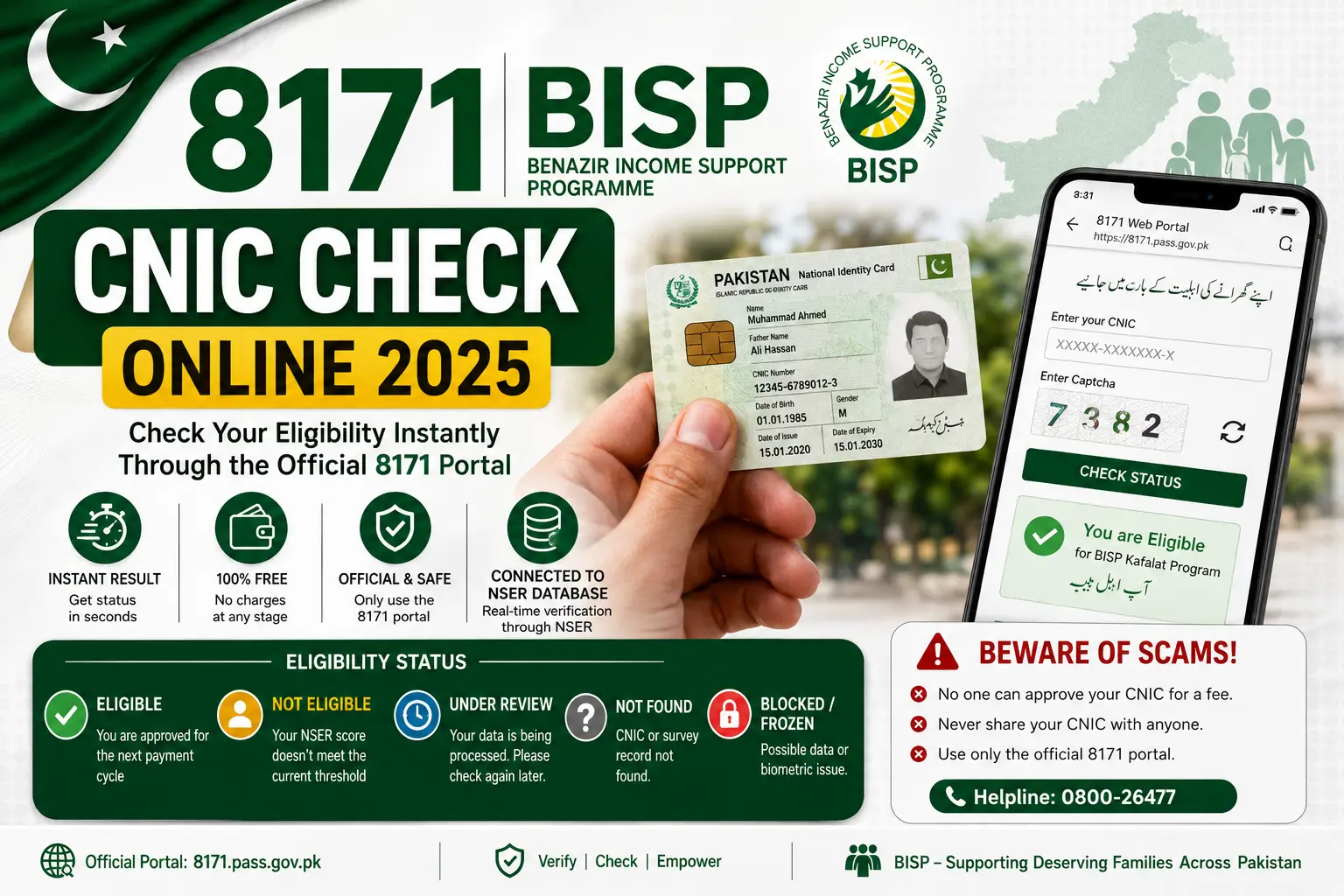
- CNIC check = real‑time eligibility lookup via the 8171 portal
- No fees — checking your status is completely free
- Result is instant — you see your status after entering your CNIC and captcha
- Eligibility is determined by NSER data, not manual approval
Where to Start (Based on Your Situation)
- If you’re checking for the first time → jump to How the CNIC Check System Works
- If you already know the basics but want to understand why results differ → read Why Two People Get Different Results
- If you’re facing a specific error → go straight to Common Issues & Fixes
- Need the official step‑by‑step portal walkthrough? Use my detailed companion guide: Online eligibility check 2025
How the 8171 CNIC Check System Works
Based on how the system operates in 2025, the 8171 CNIC check is not a random approval tool. It works through structured verification layers connected to NSER data.
When you enter your CNIC, the system typically checks:
- Your household’s registration status in the NSER database
- The poverty score (PMT score) assigned during the survey
- Any previous payment history (if already registered)
- Your eligibility category — new applicant, active beneficiary, or blocked record
What most people don’t realize is that eligibility is not based on a single income factor. Instead, it’s calculated through a multi‑variable scoring system that evaluates household structure, income stability, and socio‑economic indicators collected during the NSER survey. In most observed cases, two neighbours with similar incomes get different results precisely because of these additional layers.
If you want to see exactly what the portal looks like and how to navigate it, I’ve covered every screen here:
Online eligibility check 2025 – step‑by‑step
And if you’re curious about how the PMT score and NSER database are structured behind the scenes, I explain that in depth in my verification system article:
CNIC verification system – how the database works
Why Two People Can Get Different CNIC Results
One of the most common misunderstandings I see is people assuming that similar income levels should produce the same eligibility result. In reality, the system does not work this way.
The CNIC verification system may show different results because:
- One household has updated NSER data, while another has outdated or missing survey records
- One record is active, while another is under verification review
- Biometric or identity mismatches exist in the database
- The household’s PMT score falls just above or below the cutoff threshold — even a small difference matters
From a system perspective, eligibility is less about “income comparison” and more about data completeness and verification accuracy. I’ve seen users with identical financial situations receive different statuses simply because one had a more recent survey entry.
⚠️ Common Mistakes Users Make in CNIC Check
I’ve seen most users misinterpret their CNIC result due to simple misunderstandings. Here are the most frequent mistakes I come across:
- Checking on fake portals instead of the official 8171 system
- Expecting instant approval right after completing the NSER survey
- Assuming eligibility is income‑only based, ignoring household composition and other factors
- Not updating NSER survey information when family circumstances change
- Ignoring “under review” status and assuming it means rejection
Avoiding these will save you a lot of confusion. The next section tells you exactly how to read your actual result.
🧾 How to Read Your CNIC Result (Quick Interpretation)
When you check your CNIC, you’ll typically see one of these statuses. Here’s what each one means for you:
| Status | Meaning | Your Next Step |
|---|---|---|
| Eligible | You are approved for the next payment cycle | Check payment details and collection method (see payment guide) |
| Not eligible | Your NSER score doesn’t meet the current threshold | Understand registration options (see registration guide) |
| Under review | Your survey data is still being processed | Wait; recheck after a few weeks. Read the application status guide |
| Not found | Your CNIC is missing or the survey record is outdated | Verify your survey status, then use the CNIC error fix guide |
| Blocked / Frozen | Possible biometric or data issue | Contact the BISP helpline (0800-26477) and visit a facilitation centre |
This interpretation is based on observed system behavior and will help you stop guessing.
How the Verification Process Actually Flows
From analyzing repeated cases, the sequence is always the same:
- CNIC entered into the 8171 portal
- NSER database match is triggered
- Household profile is retrieved
- PMT score evaluation is applied
- Eligibility status is generated
- System returns result — eligible, not eligible, under review, or error
- SMS notification is sent if the mobile number is linked
This process is fully automated. There is no manual officer approval at the CNIC check stage. So if someone says they can “approve” your CNIC for a fee, it’s a lie — and that brings me to something very important.
What to Do If You’re Facing Issues
I’ve seen many users run into problems that are actually solvable with the right steps.
Common scenarios I encounter:
- Your CNIC says “not found” despite being surveyed
- The portal shows “application under review” indefinitely
- Your name is missing from local verification lists
- There’s a mismatch in your CNIC spelling or biometrics
For the first two, I recommend starting with the application status guide that explains what each status message means and typical timelines:
Application status check – understand pending results
If the CNIC itself seems broken in the database (mismatch, biometric error), I’ve written a dedicated fix guide based on what actually works at facilitation centres:
Fix CNIC errors in BISP – what to do step by step
And when the online portal isn’t cooperating, some users have success checking their name through the local district verification list. I explain when to use that alternative here:
BISP verification list check – offline alternative
My Personal Safety Advice
From what I’ve observed across multiple system updates, the biggest risk you face is not eligibility rejection — it’s misinformation.
I always advise users:
- Never trust unofficial websites asking for CNIC confirmation
- Never share your CNIC with random WhatsApp numbers or Facebook pages
- Always verify status only through the official 8171 portal (pass.gov.pk)
- Do not pay any agent for “CNIC approval” or “eligibility fix”
The 8171 system is completely free, and any payment demand outside official channels is a clear scam indicator. If you’re unsure whether a message is genuine, cross‑check it against the official helpline (0800-26477) or use the portal directly. Nobody can fast‑track your eligibility.
What I Recommend You Read Next
Once you understand your eligibility status, the next logical step depends on what the system shows you:
- If you are eligible → you need to learn about payment collection schedules and biometric withdrawal. The payment guide covers that.
- If you are not eligible → you probably need to understand how registration and NSER surveys work. That’s covered in the registration guide.
- If your result is unclear → revisit the application status guide or the CNIC fix article mentioned above.
- If you want the big‑picture view of the entire BISP/Ehsaas programme, the master guide is here: 8171 Ehsaas master guide
If you’re unsure about your result, I recommend starting from the main BISP guide or checking your payment status next — because eligibility and payments are directly connected in the 8171 system.
Common Questions I Get About CNIC Checks
1. How can I check my CNIC online in 8171 right now?
Go to the official portal, enter your CNIC, and solve the captcha. I’ve laid out every screen in the eligibility check guide.
2. Why does my CNIC show “not found” even though I was surveyed?
It usually means your survey data hasn’t synced properly or there’s an identity mismatch. My error‑fix guide walks through the correction process.
3. Is there any fee for checking CNIC status?
No. Never. If someone asks for money, it’s a scam — period.
4. What does “pending” or “under review” mean?
Your household data is still being processed in the NSER system. The application status guide explains typical waiting periods.
5. Can I check my CNIC via SMS?
Yes, send your CNIC to 8171. But I recommend using the portal because it gives more detailed information.
6. What is the PMT score and why does it matter?
It’s a multidimensional poverty score calculated during the NSER survey. I explain it fully in the verification system article.
7. I have the same income as my neighbor — why am I not eligible?
Because the system uses more than just income. Household composition, survey date, and data completeness all affect the outcome. See the section “Why Two People Get Different Results” above.
8. How can I fix a biometric mismatch?
Visit a BISP facilitation centre with your original CNIC and a family member’s CNIC. The CNIC error guide has the exact documents you’ll need.
9. Is there an offline way to check my name?
Yes, some districts release verification lists. I’ve explained how to use those in the verification list check article.
10. How often should I check my CNIC status?
At least once before each quarterly payment cycle to make sure nothing has changed.
Key Takeaways
- The 8171 CNIC check is a direct digital interface with the NSER database — not a standalone application form.
- Eligibility depends on multiple data points, not just your income.
- Results are instant and automated — no human approval is involved at the checking stage.
- Never pay anyone for CNIC checks or eligibility promises; the official system is completely free.
- If you encounter errors, there are clear correction paths — start with the guides I’ve linked above.
- Your next action depends entirely on your result: payment collection, registration, or error resolution.
This guide is continuously structured based on how the 8171 system operates in real‑world usage and user behavior patterns. While government policies may change, the core verification mechanism of CNIC‑based eligibility through NSER remains the foundation of the system.
Disclaimer: I am an independent researcher and information provider, not affiliated with the Government of Pakistan or BISP. Always verify official announcements through pass.gov.pk.