BISP 8171 Awareness Campaign 2025 guides beneficiaries to spot scams, verify official messages, protect CNIC data, and stay safe through trusted BISP channels
Introduction – Why Awareness Is Critical
In 2025, the Benazir Income Support Programme (BISP) has reached a new milestone—not only in digital payments but also in digital protection. With millions of beneficiaries relying on monthly stipends, BISP has launched a nationwide 8171 Awareness Campaign 2025 to shield citizens from rising cases of fraud and fake registrations.
For years, thousands of families have been tricked by phone calls that sound official, by agents who claim to “speed up” registration, or by messages that promise extra cash if the receiver shares their CNIC number. Each such act not only steals people’s money but also damages their trust in the system built for them.
BISP realized that technology alone cannot ensure transparency—education and awareness must go hand-in-hand. Hence, the 8171 campaign aims to teach every beneficiary how to recognize scams, verify official messages, and protect personal data. It’s more than a campaign; it’s a national movement toward digital safety and beneficiary empowerment.
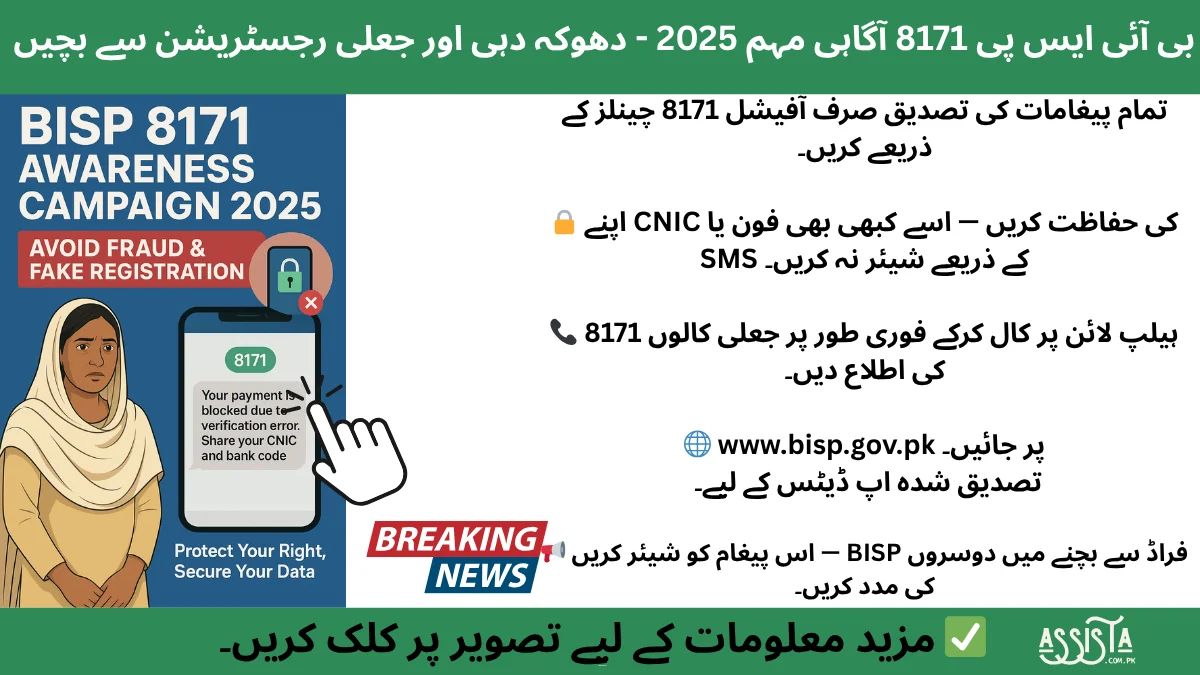
Consider the story of Rukhsana Bibi, a widow from Multan. She once received a message claiming her payment was “blocked due to verification error.” In panic, she called the number back and was asked for her CNIC and bank code. Within minutes, she lost her balance and access to her BISP account. Later, through a community meeting held under the new campaign, she learned how to identify fake numbers and how to verify alerts using the official 8171 portal. That small lesson changed her approach—and saved her next payments.
Awareness like this is exactly what BISP wants to spread: the power to question before you trust.
Overview of the 8171 Awareness Campaign
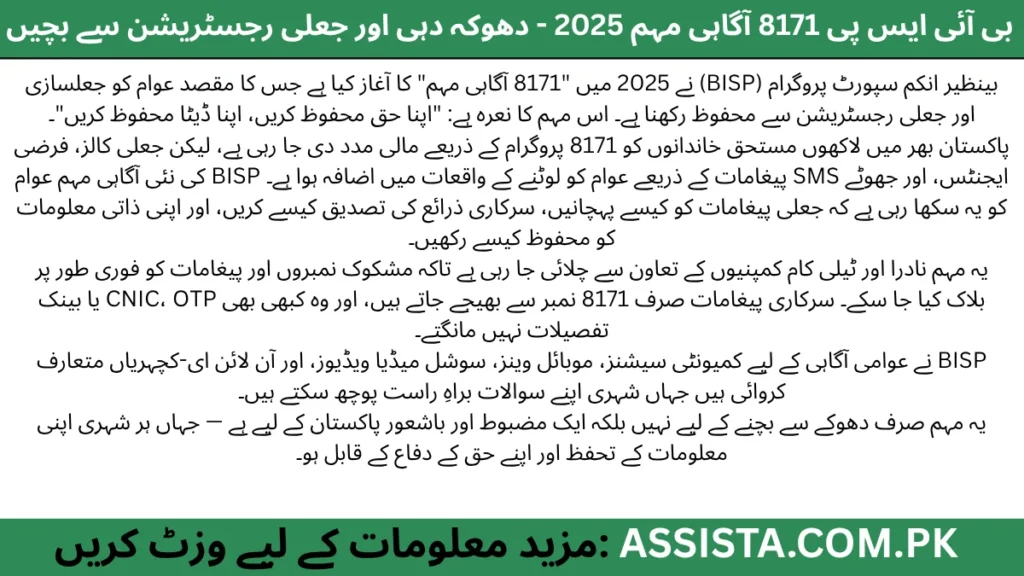
The BISP 8171 Awareness Campaign 2025, launched in collaboration with NADRA, is built around one simple idea—“Protect Your Right, Secure Your Data.” It’s not just an online drive; it’s a multilayered system connecting SMS alerts, verified websites, community sessions, and live awareness shows.
Under this initiative, BISP and NADRA jointly verify data in real time, ensuring that only genuine beneficiaries remain in the system. The campaign’s backbone is its official warning mechanism—a set of SMS alerts and portal updates designed to prevent misuse of CNIC numbers and to inform users about fraudulent attempts circulating nationwide.
One of the strongest aspects of the 2025 campaign is its inclusivity. Awareness messages are delivered in regional languages so every citizen—from Karachi to Khuzdar—can understand the message clearly. Digital kiosks and mobile information vans visit remote villages, teaching people how to check their registration safely.
Officials have also strengthened collaboration with telecom providers. This allows fake SMS patterns and suspicious numbers to be detected early and blocked before they reach more people.
Most importantly, BISP has introduced verified digital channels:
- The official 8171 SMS service (for eligibility and payment updates)
- The BISP portal and mobile app
- The verified social-media pages displaying blue-tick badges
These channels form the campaign’s foundation for trustworthy communication.
Through these steps, BISP 8171 Awareness Campaign 2025 doesn’t only stop scams—it rebuilds confidence that beneficiaries’ rights and data truly belong to them.
Common BISP 8171 Scams to Watch Out For
Unfortunately, fraudsters have become more sophisticated with time. The campaign highlights several common BISP 8171 scams that every beneficiary should recognize instantly:
- Fake Phone Calls:
Callers pretending to be “BISP officials” often say, “Your payment is on hold; share your CNIC for activation.” Once shared, they use this data to impersonate beneficiaries and withdraw funds. - Phishing SMS Messages:
Fraudulent texts promising extra allowances or bonus payments redirect victims to fake websites. These pages steal CNIC, phone, and bank details. - Unofficial Agents:
Some self-proclaimed “facilitators” claim they can register new families quickly—for a small fee. In reality, registration through any third party is illegal and completely unnecessary. - Social Media Traps:
Fake Facebook pages or WhatsApp groups use the BISP logo to collect personal data. Beneficiaries often believe them because of copied design elements.
Real-life case studies show how dangerous such scams can be. In Hyderabad, a man was arrested after collecting money from over fifty women, promising them “urgent inclusion in the new payment list.” Many victims didn’t even realize they had been scammed until the awareness drive reached their community center.
BISP now publishes monthly scam alerts highlighting such incidents to keep beneficiaries alert. The message is clear: if anyone asks for money, personal information, or OTP codes, it is fraud—period.
How to Identify Official BISP Notifications
Knowing what not to trust is half the battle—but understanding how to identify official BISP notifications completes the protection cycle.
Every legitimate BISP message originates from the shortcode 8171. The text is concise, never asks for CNIC or banking details, and always references either eligibility, payment confirmation, or survey updates.
Beneficiaries can double-verify authenticity in three ways:
- Through the official portal: visit www.bisp.gov.pk or the dedicated 8171 portal. Both domains end in “.gov.pk,” the hallmark of official communication in Pakistan.
- By checking verified social-media accounts: BISP’s Facebook, X (Twitter), and YouTube pages carry blue verification ticks. Any page without this mark should be ignored.
- By calling the helpline 8171: beneficiaries can confirm whether any message or call came from the program itself.
The campaign also trains citizens to recognize visual authenticity—official messages contain the BISP logo, clean formatting, and Urdu-English bilingual text crafted for clarity. In contrast, scam messages usually include spelling errors, long paragraphs, or informal tone.
A beneficiary from Peshawar shared her experience during an awareness session: she had received a text offering “double payment bonus.” Remembering what she had learned, she compared it with the original message style from 8171 and realized the scam immediately. Her quick thinking prevented potential data theft.
This growing sense of vigilance across communities is exactly what the BISP 8171 fraud awareness initiative intends to achieve. The goal isn’t only to warn—it’s to empower every citizen to differentiate between truth and deception with confidence.
Steps to Protect Yourself From Fraud
In an era where scams evolve faster than most people can recognize them, fraud prevention is no longer optional—it’s essential. The BISP 8171 Awareness Campaign 2025 focuses on practical, easy-to-follow steps that every beneficiary can use daily to safeguard themselves from fraudulent activity.
Step 1: Never share your CNIC or banking details with anyone.
This is the golden rule. No official representative will ever ask you to disclose your CNIC, account PIN, or mobile code over the phone. If someone does, they are not from BISP—no matter how convincing they sound.
Step 2: Always verify suspicious messages.
Before reacting to any alert or payment message, confirm it via the official BISP 8171 portal or helpline. Many scams rely on panic—creating a sense of urgency like “your payment will be blocked in 2 hours.” Take a breath, verify, then act.
Step 3: Stay connected with official channels.
Follow only verified BISP social media pages and WhatsApp broadcast lists. The program regularly posts scam warnings, awareness videos, and official updates there.
Step 4: Report every suspicious activity.
Don’t ignore fake messages thinking “it’s just one text.” Reporting even a single scam helps BISP track fraud networks. You can report directly through 8171 helpline or the complaint form available on the official website.
A strong example comes from a rural area in Sindh, where a women’s community center trained under this campaign identified a fraudulent WhatsApp group pretending to be “BISP Online Help.” When they reported it through the official complaint channel, BISP and PTA jointly blocked that number within 24 hours. That quick response prevented dozens of families from being scammed.
Such stories reflect the campaign’s real purpose — transforming ordinary beneficiaries into active protectors of their own rights.
Safe Registration Tips for Beneficiaries
Safe registration is the cornerstone of beneficiary protection in 2025. As digital transformation expands, scammers continuously look for new ways to trick people during sign-ups. That’s why BISP’s safe registration guide emphasizes clarity, caution, and verification.
Here’s how you can register without risk:
✅ Use Only Official BISP Channels
All registrations happen through 8171 SMS or the official BISP portal. Send your CNIC number directly to 8171, and you’ll receive a reply confirming eligibility or next steps. Any message from another number is fake—ignore it immediately.
✅ Avoid Third-Party Agents
One of the major fraud patterns BISP identified in 2024 was fake agents offering “priority registration.” In reality, they either disappear after collecting money or misuse the shared CNIC for identity theft.
BISP registration is completely free, whether online or in person. If anyone demands payment, it’s a scam.
✅ Double-Check Family and CNIC Information
Sometimes, fraud occurs not because of hackers but due to small mistakes in data. Make sure your CNIC number, family details, and mobile number are all correct before submission. Wrong data can cause payment delays or false rejection messages.
✅ Keep Your Registration Confidential
Never post your CNIC, form number, or confirmation message screenshots on social media. Scammers use those images to clone digital identities.
✅ Visit Authorized BISP Centers for Help
If you face registration issues, go only to official BISP Tehsil Offices. Staff there are trained to assist free of cost.
Take the case of Zulfiqar, a daily-wage worker from Bahawalpur. When he received a message from an unknown number asking for Rs. 300 for “form approval,” he almost paid. But remembering the campaign message—“BISP is always free”—he decided to verify through the official helpline. The call saved him not just Rs. 300, but possibly his data too.
Each safe decision like this strengthens the system and discourages scammers from targeting more people.
Safe registration isn’t just about data entry—it’s about building trust. When beneficiaries follow official routes, they protect not only themselves but also the integrity of the national welfare network.
How BISP Communicates Fraud Alerts
The BISP 8171 fraud awareness initiative is unique because it doesn’t wait for scams to happen—it actively sends alerts before fraud spreads. Communication has become the heart of this campaign, ensuring that beneficiaries receive clear, verified, and timely information.
Here’s how BISP communicates fraud alerts across Pakistan:
1. Official SMS Alerts
All warnings and eligibility updates are sent only through the verified 8171 number. These alerts inform people about fake campaigns, survey deadlines, or changes in payment schedules. The system now uses advanced filters to block fake sender IDs pretending to be “8171.”
2. Real-Time Portal Updates
The official BISP portal displays fraud warnings, safety guides, and awareness posters in both English and Urdu. Every update includes the date and verification code so users can confirm authenticity.
3. Verified Social Media Announcements
With millions of Pakistanis active online, BISP has strengthened its digital presence. All verified pages on Facebook, X (Twitter), and YouTube now share official awareness videos, complaint procedures, and fraud prevention tips.
4. E-Live Katcheri Sessions
To reach people who prefer direct communication, BISP officials host monthly E-Live Katcheris—interactive sessions streamed online. During these events, beneficiaries can ask questions live about fake messages or registration confusion. The recorded sessions are later shared on official platforms for public viewing.
5. Community Awareness Drives
In collaboration with NADRA and local administration, BISP organizes on-ground seminars in schools, mosques, and community halls. These sessions use posters, banners, and real-life examples to help beneficiaries understand common fraud patterns.
One memorable story came from Gilgit, where a teacher attending a community seminar realized that her elderly parents had been saving every “BISP message” they received, including many from unknown numbers. After the session, she helped them identify which were fake and guided them to report the suspicious numbers. That single act led to the blocking of several fraudulent lines in her area.
Through such local heroes and real stories, the campaign builds more than awareness—it builds a culture of vigilance.
Benefits of Participating in the Awareness Campaign
Joining the BISP 8171 Awareness Campaign 2025 is more than just attending a session or reading an SMS — it’s a commitment to protect yourself and your community. The campaign brings a series of benefits that go far beyond fraud prevention.
1. Financial Safety and Security
Every participant learns how to protect their payment information and avoid falling into scam traps. By understanding the difference between official and fake communications, beneficiaries can ensure their BISP disbursement process remains safe, smooth, and uninterrupted.
2. Timely Access to Payments
Those who stay informed are less likely to face delays. Many payment holds occur because of incomplete verification or wrong data shared through unofficial channels. The campaign teaches how to fix those errors quickly through verified BISP portals or 8171 SMS.
3. Stronger Trust in the System
When beneficiaries know how the system truly works, they stop fearing it. Trust grows when people realize that BISP doesn’t take money from anyone for registration or inclusion — and that official representatives are always available to help free of cost.
4. Awareness Spreads Safety
One educated individual can save dozens from scams. Many community workers trained under this campaign now act as local ambassadors, spreading messages of safety in their neighborhoods.
A perfect example is Saeeda Begum from Dera Ghazi Khan. She was initially hesitant to attend a BISP awareness session, thinking it wouldn’t matter. But after learning how fake SMS scams operate, she started guiding others in her village. Within weeks, scam incidents in her area dropped noticeably — a real proof that awareness multiplies protection.
5. Empowerment and Confidence
Knowledge gives confidence — especially to those who rely on support programs. After attending awareness workshops, beneficiaries report feeling more empowered. They now know where to verify, whom to trust, and how to act when they receive suspicious messages.
Through this campaign, BISP isn’t just distributing money; it’s building digital confidence among Pakistan’s most vulnerable families — helping them stand against manipulation and fraud.
Reporting Fraud – Step-by-Step
Knowing how to report fraud is just as important as avoiding it. The BISP 8171 Awareness Campaign 2025 has made reporting faster, simpler, and completely transparent. Every beneficiary now has access to multiple complaint channels to stop scams in their tracks.
Here’s how to do it safely:
Step 1: Contact the Official Helpline (8171)
Dial 8171 and choose the “complaint” option from the menu. You’ll be connected to a trained representative who will record your issue.
Step 2: Provide Required Details
Share your CNIC number, a short summary of the fraud (for example: fake call, SMS, or agent), and any supporting evidence like a phone number or screenshot.
Step 3: Receive a Complaint ID
Once submitted, the system automatically generates a Complaint ID. This ID helps track your report’s progress — ensuring every case is monitored from start to resolution.
Step 4: Follow Up
You can check your complaint status anytime by calling 8171 again or visiting the official BISP portal.
Step 5: Stay Updated Through Alerts
When your complaint is resolved or verified, you’ll receive a confirmation SMS from 8171.
Beneficiaries can also report directly through WhatsApp support or in-person at BISP Tehsil Offices. For severe fraud cases, BISP collaborates with NADRA and FIA to trace digital footprints and block criminal accounts.
Consider the case of a young woman in Quetta who lost her payment due to a cloned CNIC scam. When she filed a complaint using this new process, her case was resolved within a week, and the scammer’s number was permanently banned. Her experience has since been shared in awareness sessions as an example of how reporting truly creates change.
The system only works when beneficiaries participate actively — so every complaint matters.
Final Advice – Stay Vigilant and Updated
Fraudsters are always inventing new tricks — but informed citizens are harder to fool. The BISP 8171 Awareness Campaign 2025 reminds every Pakistani beneficiary that protection is not a one-time effort; it’s a continuous habit.
Here are three golden rules to stay safe in 2025 and beyond:
1. Trust Only Official Channels
Whether it’s registration, survey updates, or payments — use 8171 SMS, the official BISP portal, and verified social media only.
2. Stay Curious, Stay Alert
Whenever something sounds too good to be true — like “double payment offers” or “special inclusion lists” — it usually is. Always cross-check before reacting.
3. Educate Others Around You
Fraud awareness becomes stronger when it’s shared. Tell your family, neighbors, and friends about these scams. Even a simple reminder can prevent someone’s financial loss.
BISP has pledged to keep improving its systems — adding stronger verification tools, AI-based fraud detection, and wider public outreach. But true protection will always depend on one thing: awareness at the grassroots level.
In the end, the message is clear —
Awareness is empowerment. Verification is safety. And trust only grows when citizens and institutions work hand in hand.
The BISP 8171 Awareness Campaign 2025 is not just protecting funds; it’s protecting hope.
10 FAQs – User-Intent Focused
💬 Top 10 FAQs
1. What is the BISP 8171 Awareness Campaign 2025?
It’s a national initiative launched by BISP and NADRA to educate beneficiaries on identifying fake messages, preventing fraud, and ensuring safe registration.
2. How do I know if a BISP message is fake?
Only messages from 8171 are official. If the SMS comes from another number, asks for CNIC, or promises extra payments — it’s a scam.
3. Can I report a BISP scam or fraud?
Yes, you can report through the 8171 helpline, the official BISP website, or at your nearest BISP office. Each complaint receives a unique tracking ID.
4. What are common BISP 8171 scams?
Fake calls, phishing SMS, unofficial agents, and social media traps pretending to be official pages.
5. How can I safely register as a BISP beneficiary?
Send your CNIC to 8171 or register via the official BISP portal. Avoid any middleman or paid service.
6. Does BISP send SMS alerts for fraud?
Yes. Fraud prevention alerts are regularly sent via 8171, along with updates on new scam patterns or warnings.
7. How can I verify official BISP notifications?
Check only www.bisp.gov.pk or verified social media accounts with blue-tick marks.
8. What should I do if I shared CNIC with a fake agent?
Immediately call 8171 or visit the nearest BISP office to report and secure your record before misuse occurs.
9. How can family members protect themselves from BISP fraud?
Share safety tips within the household — like never revealing CNIC numbers, ignoring unknown messages, and confirming everything through 8171.
10. Where can I find official BISP fraud prevention resources?
All awareness materials, guides, and alerts are available on the BISP official website, verified pages, and community awareness centers across Pakistan.
Final Wrap-Up
The BISP 8171 Awareness Campaign 2025 represents more than policy—it’s a promise.
A promise that every Pakistani, regardless of location or literacy level, deserves to know how to protect their financial rights.
From Karachi’s urban families to the rural heartlands of Balochistan, the campaign carries one consistent message: Trust only official sources, stay alert, and empower others through awareness.
Fraud may evolve, but so will the people — informed, alert, and united under one secure system.
Still Confused or Need Help?
If you’re unsure about your eligibility, registration process, or want direct updates from our team — join our official WhatsApp Channel where we share all latest BISP 8171 and government scheme updates step-by-step.
Tap the button below to join our verified WhatsApp channel.
💬 Join WhatsApp ChannelStay updated — we’ll guide you until your BISP or government application process is successfully completed.
Disclaimer / اطلاع برائے عوام
English: This article has been prepared by Saleh Ashraf for public awareness regarding BISP 8171 Awareness Campaign 2025 – Empowering Citizens to Avoid Fraud & Fake Registrations. It is not officially affiliated with the Benazir Income Support Programme (BISP) or any government department. For accurate verification, always use the official BISP portal or call the verified helpline 0800-26477.
Roman Urdu (اہم نوٹ): Yeh maloomat sirf public awareness ke liye hai. Is website ka BISP ya kisi hukoomati idaray se koi ta’alluq nahi hai. Apni asal tasdeeq sirf 8171.bisp.gov.pk ya BISP helpline par karein. Kisi bhi WhatsApp message, 03xx number ya fake link par apna CNIC ya personal data share na karein.
Report Fraud: Agar aapko koi suspicious call, SMS, ya fake app mile jo BISP 8171 ka dawa kare, report karein: PTA Complaint Portal, call FIA Cyber Crime (1991), ya apne qareebi BISP Tehsil Office par jaaen.
🔗 Visit Official BISP Website
Saleh Ashraf
Founder of Assista.com.pk
Hi, I’m Saleh Ashraf — a passionate blogger, researcher, and digital educator with over 7 years of experience in blogging, online awareness, and government program analysis. I started Assista.com.pk to help people across Pakistan better understand and benefit from the BISP 8171 Program and other national welfare schemes.
My goal is simple: to make sure every visitor gets clear, verified, and step-by-step guidance about registrations, payments, and updates related to government initiatives. With a strong background in research and content writing, I ensure every article published here is reliable, practical, and genuinely useful for the public.
Beyond BISP 8171, I also share updates on Ehsaas Program, utility relief schemes, and government financial support systems, empowering families to access the help they deserve with confidence and clarity.
📍 Based in Pakistan
💼 Government Awareness Blogger | BISP Program Researcher
🔔 Your trusted source for verified welfare updates and guidance across Pakistan.