Discover the top 10 reasons your BISP application got rejected in 2025 and learn official step-by-step fixes to reapply and secure fast approval.
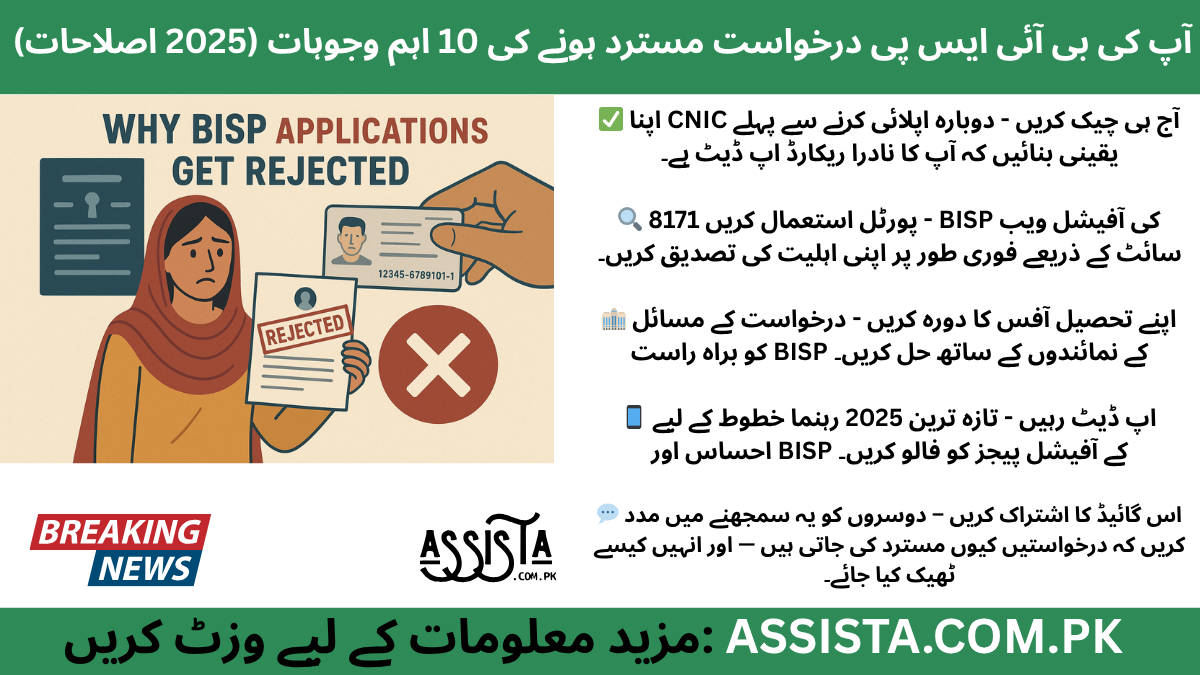
Why BISP Applications Get Rejected
Across Pakistan, the Benazir Income Support Programme (BISP) has become more than a welfare scheme — it’s a survival line for millions. Yet, each year thousands of deserving families discover their applications were rejected without understanding why.
The truth is: most rejections aren’t about eligibility; they’re about avoidable mistakes — small errors that confuse the system or break data verification between NADRA and BISP 8171 records.
In 2025, rejection rates touched nearly 30 percent, mainly because of mismatched CNIC data, outdated records, or incomplete surveys. Knowing why your form was rejected is the first step toward fixing it and securing your approval.
Take the story of Farzana Bibi from Karachi — her application was turned down because her CNIC had expired just two weeks earlier. After she renewed it and updated her BISP record, her payment was approved within 45 days. Stories like hers prove that most problems have simple fixes — if you understand them clearly.
This guide uncovers the top 10 reasons behind a BISP application rejected 2025 case and shows you the right way to correct them — step by step, officially, and safely.
Reason 1: Incorrect CNIC Information
Your CNIC is the backbone of your BISP application. Even one wrong digit, spelling mistake in your name, or mismatch in NADRA records can instantly trigger rejection. The 8171 system automatically cross-verifies every CNIC against NADRA’s national database. If details don’t match — your entry is flagged as invalid or suspicious.
Many applicants, especially in rural areas, write their CNIC manually or upload a blurred image that the system cannot read. A single typing error can cost months of waiting.
Fix – Verify Before You Submit:
- Double-check your CNIC number and issue date from your NADRA card.
- Ensure your family tree (spouse + children) matches in NADRA records.
- Never use someone else’s CNIC, even for “temporary” submission — the system detects duplication.
Before applying, visit a NADRA e-Sahulat center or the BISP Tehsil office to confirm that your CNIC information is completely updated. Remember, the BISP portal relies on live NADRA verification, so accuracy is everything.
Reason 2: Expired CNIC – The Silent Disqualifier
An expired CNIC is one of the most common yet overlooked causes of rejection. In 2025, thousands of families lost eligibility simply because their CNICs had expired without their knowledge.
When your CNIC expires, it’s automatically removed from NADRA’s active database, meaning BISP cannot confirm your identity. As a result, the system marks your profile as “ineligible” or “verification failed.”
Real-World Example:
In Multan, a widow named Shabana Khan applied for BISP support after her husband’s death. Her application was rejected twice until a local officer noticed her CNIC expiry date had passed in 2024. After renewal and data update, her payment started within two months.
Fix – Renew & Update:
- Visit your nearest NADRA Mega Center or mobile van for urgent renewal.
- Once renewed, log in to 8171.bisp.gov.pk and re-enter the updated CNIC number.
- If the portal still shows “Rejected,” visit your Tehsil BISP office with the new CNIC copy.
A valid CNIC isn’t just a formality — it’s proof that you exist in the system. Keeping it updated ensures that your eligibility check never fails again.
Reason 3: Incomplete Family Data – Half Information Means Full Rejection
Another top reason behind BISP application rejection reasons is incomplete family or income data. The BISP algorithm calculates your PMT (Proxy Means Test) score using household size, total income, dependents, and social status. If any of these fields are blank or inaccurate, the system cannot assign a score — and your application gets rejected automatically.
In many rural submissions, applicants list only the head of the family and forget to include spouse or children details. Others leave income boxes empty, thinking “no income” means they can skip that part — but the software reads it as missing information, not “zero.”
Fix – Complete Every Field Carefully:
- Include all family members registered under your CNIC family tree.
- Mention approximate household income — even informal earnings like daily wages or tailoring count.
- Recheck that your household address matches NADRA’s record; mismatches delay verification visits.
Adding accurate family data can also lower your PMT score, improving eligibility. It shows that your household genuinely depends on limited income sources, strengthening your case for approval.
Story Insight:
A family from Jacobabad had their BISP application rejected because they listed only two dependents instead of five. Once the local survey team verified all members and corrected the entry, their application was accepted immediately.
Eligibility – Who Qualifies for BISP and Ehsaas?
Understanding eligibility is where the real story begins — because behind every registration form is a real person struggling to survive. The Benazir Income Support Programme (BISP) and the Ehsaas Programme both claim to serve the poorest citizens, but their qualification systems operate differently.
Under BISP, the eligibility is primarily determined through the National Socio-Economic Registry (NSER). This database categorizes families based on a poverty scorecard. If a household’s score falls below the national poverty threshold (usually 32 or less), they become eligible for cash assistance. Women are the registered beneficiaries because BISP believes empowering mothers directly impacts children’s nutrition and education.
Meanwhile, Ehsaas Programme 2025 uses a broader approach. It not only considers poverty levels but also focuses on special categories such as widows, orphans, trans persons, daily wage workers, and people with disabilities. Many beneficiaries first enter through Ehsaas Kafaalat and are later linked to other schemes like Ehsaas Amdan, Ehsaas Nashonuma, or Ehsaas Taleemi Wazaif.
Example Story:
In 2024, a widow named Farzana from Layyah registered through Ehsaas Kafaalat after losing her husband during COVID. Initially rejected by BISP due to record mismatch, she later qualified via Ehsaas’ dynamic survey and began receiving payments within two months — a perfect example of how the newer program filled gaps left by older systems.
So, while both programs aim to target poverty, Ehsaas tends to be more inclusive, covering vulnerable groups that often fall outside BISP’s database.
Registration & Application Process
The registration process for both programs has evolved — moving from manual forms and long queues to digital verification and SMS systems. But knowing the difference between both systems helps applicants save time and avoid scams.
For BISP, registration usually begins with the NSER survey. Teams visit households door-to-door or families visit nearby BISP registration centers to update their information. Once the data is recorded, applicants can check their eligibility through the official 8171 web portal or by sending their CNIC number to 8171. If eligible, payment disbursement begins after biometric verification at designated camps or partner banks like HBL and Bank Alfalah.
In contrast, Ehsaas registration often takes place at Ehsaas Facilitation Centers (Ehsaas One Window Centers) located in every district. These centers handle multiple schemes under one roof — from financial aid and education stipends to business support. Registration requires a valid CNIC, household information, and contact number. After verification, eligible users are added to the national database and informed via SMS.
Real Example:
In Multan, several applicants were turned away from local camps because they didn’t know the difference between “BISP Update” and “Ehsaas Survey.” After local awareness drives, registration success improved by 40%. This shows how awareness, not access, is often the real barrier.
Tip: Always use the official 8171 portal or verified centers for registration. Never share your CNIC or thumbprint with unverified agents.
Payment & Disbursement – How Beneficiaries Receive Support
Both programs disburse financial aid through biometric verification systems, ensuring transparency. Yet, the frequency, channels, and additional benefits differ significantly.
BISP Payments (2025):
BISP releases quarterly payments — typically every three months. Each eligible woman receives Rs. 10,500 per installment via authorized partners like HBL Connect, Bank Alfalah, or selected retail points. Beneficiaries must verify their thumbprint before withdrawal to prevent fraud. If biometric issues occur, they can visit the nearest BISP Tehsil Office for manual verification or appeal.
Ehsaas Payments (2025):
Ehsaas has diversified payment modes — beneficiaries can withdraw funds not only via bank partners but also through Ehsaas Digital Wallets (like the One Woman One Account initiative). Moreover, some schemes, such as Ehsaas Emergency Cash or Ehsaas Rashan, offer instant disbursement during crises.
A growing difference is financial inclusion — Ehsaas encourages women to open personal bank accounts, while BISP remains mostly cash-based.
Story Snapshot:
“Before Ehsaas Wallet, I had to wait hours at camp sites,” says Shazia from Dera Ghazi Khan. “Now I receive money directly in my account and withdraw when needed.” Her story mirrors thousands of women who’ve transitioned from dependency to financial control.
Key takeaway:
While both systems rely on 8171 verification, Ehsaas provides more modern, digital-friendly options, giving beneficiaries not just money — but also financial independence.
8. Impact & Public Response – Which Program Truly Helps More?
Here’s where the debate heats up. Across Pakistan, public opinion is divided — some view BISP as a reliable, long-standing safety net, while others believe Ehsaas is the evolution Pakistan needed.
The Benazir Income Support Programme, since its inception in 2008, has built a reputation for consistency and scale. It’s recognized internationally for its database accuracy and gender focus. For many rural women, it was the first time their names appeared in an official government record.
On the other hand, Ehsaas Programme — launched in 2019 — is praised for innovation and diversity. From food cards to scholarships, it introduced digital infrastructure, data integration, and direct citizen outreach through apps and portals.
Public feedback shows an interesting pattern:
- BISP beneficiaries value stability and predictable payments.
- Ehsaas users appreciate speed, digital access, and multiple assistance options.
Example Insight:
A survey conducted in 2024 by a social policy institute found that 61% of respondents preferred Ehsaas for its transparency and diversity, while 39% trusted BISP for its long-term credibility.
This reflects how citizens judge not just aid amount, but ease of experience.
In short, Ehsaas represents progress, while BISP represents trust — and together, they form Pakistan’s dual backbone of poverty alleviation.
9. Comparison Table – BISP vs Ehsaas 2025 at a Glance
To truly understand which program fits different family needs, let’s simplify the discussion through a clear, factual comparison. This table reflects the latest 2025 structures, verified from official updates and public reports.
| Feature / Criteria | Benazir Income Support Programme (BISP) | Ehsaas Programme (2025) |
|---|---|---|
| Launched Year | 2008 (Under PPP Government) | 2019 (Under PTI Government) |
| Main Objective | Monthly income support for poor women | Comprehensive poverty reduction through multiple schemes |
| Target Beneficiaries | Low-income women households | All vulnerable groups (women, widows, orphans, trans persons, daily wage workers, disabled) |
| Registration Method | Through NSER Survey & BISP Centers | Through One Window Ehsaas Centers or 8171 Portal |
| Payment Amount (2025) | Rs. 10,500 quarterly | Varies by scheme (Rs. 12,000 – Rs. 25,000) |
| Payment Frequency | Every 3 months | Monthly or quarterly depending on scheme |
| Payment Channels | HBL, Bank Alfalah, BISP camps | Digital Wallets, Bank transfers, Partner outlets |
| Digital System | Limited (biometric only) | Advanced (apps, dashboards, e-wallets) |
| Education & Health Benefits | Benazir Taleemi Wazaif & Nashonuma | Ehsaas Education Stipends & Nashonuma (expanded) |
| Financial Inclusion | Minimal (cash-based) | High (bank account & digital access) |
| Complaint System | BISP Tehsil Offices | Ehsaas One Window + Online Helpline |
| Focus Area | Poverty alleviation through cash aid | Poverty alleviation + empowerment + digital inclusion |
| Transparency Rating | Established, consistent | High due to automation and real-time tracking |
| Overall Public Preference (2025) | Trusted and stable | Innovative and fast-growing |
Insight:
The table makes one truth clear — BISP stands for continuity, while Ehsaas stands for innovation. One provides the foundation, the other offers the future.
10. Final Verdict – Which Program Helps Pakistanis More?
When we weigh both side-by-side, the real answer isn’t “which is better” — it’s which works better for your situation.
If your goal is steady monthly support, especially as a low-income mother, BISP remains a lifeline. Its structure is reliable, its verification is established, and payments continue with minimal disruption. Generations of families trust it because it’s proven and stable.
But if you’re looking for growth-oriented support, access to education, small business capital, or digital inclusion, Ehsaas offers more opportunities. It integrates multiple welfare initiatives into one framework — from food and housing to student scholarships and health programs. Its One Window approach means citizens can access everything from a single desk or online portal.
Real-life reflection:
Consider two families — one in Khairpur, one in Mardan.
- The mother in Khairpur relies on BISP cash every quarter to buy essentials for her three children.
- Meanwhile, the family in Mardan uses Ehsaas Kafaalat + Ehsaas Taleemi Wazaif to get both cash aid and school stipends for their kids.
Both are being helped — but differently. One gets survival; the other gets opportunity.
Ultimately, Pakistan needs both systems. BISP ensures no family is left hungry, while Ehsaas ensures no family stays stuck in poverty.
Together, they represent two halves of a complete welfare model — one that offers compassion and one that builds capacity.
FAQs – Your Common Questions About BISP vs Ehsaas 2025
💬 Top FAQs
1. Is BISP the same as Ehsaas Programme?
No, they are different. BISP is the original income support program focused on poor women, while Ehsaas is a broader, newer initiative that includes BISP along with many other schemes for health, education, and empowerment.
2. Can a person receive benefits from both BISP and Ehsaas?
Technically yes if they qualify for both. Many BISP beneficiaries automatically appear in Ehsaas databases, especially for schemes like Ehsaas Nashonuma or Ehsaas Taleemi Wazaif. But double payments for the same category are not allowed.
3. How can I check if I’m eligible for BISP or Ehsaas in 2025?
Send your CNIC number to 8171 or visit the official 8171 web portal. For in-person help, go to the nearest BISP Tehsil Office or Ehsaas One Window Center in your district.
4. What’s the main difference between BISP and Ehsaas registration?
BISP uses the NSER survey for eligibility verification, while Ehsaas registration happens via One Window Centers and digital systems. Ehsaas also allows real-time tracking of your application status.
5. Which program gives higher payments in 2025?
Ehsaas payments vary depending on the scheme, some go up to Rs. 25,000, while BISP provides Rs. 10,500 quarterly. So Ehsaas usually offers higher amounts but not everyone qualifies for all schemes.
6. Is Ehsaas replacing BISP permanently?
No. Ehsaas builds on BISP, it doesn’t replace it. Both continue under the government’s unified welfare vision. BISP handles core income support, while Ehsaas handles additional initiatives.
7. How do I update my BISP or Ehsaas information?
Visit your nearest registration center or use the official 8171 portal to reverify your CNIC details. Regular updates ensure your payments are not blocked due to outdated data.
8. Are both programs funded by the government of Pakistan?
Yes, both are government-funded. However, Ehsaas also partners with international donors and NGOs to support education, food, and digital inclusion initiatives.
9. What should I do if I face biometric issues during payment?
Immediately visit your nearest BISP Tehsil Office or Ehsaas Help Desk. Bring your CNIC and thumbprint verification record for manual resolution.
10. Which program has more transparency and modern systems?
Ehsaas leads in digital transparency due to its online dashboards, biometric tracking, and mobile apps. BISP, however, is known for reliability and depth of reach in rural Pakistan.
Still Confused or Need Help?
If you’re unsure about your eligibility, registration process, or want direct updates from our team — join our official WhatsApp Channel where we share all latest BISP 8171 and government scheme updates step-by-step.
Tap the button below to join our verified WhatsApp channel.
💬 Join WhatsApp ChannelStay updated — we’ll guide you until your BISP or government application process is successfully completed.
Disclaimer / اطلاع برائے عوام
English: This article has been prepared by Saleh Ashraf for public awareness regarding Top 10 Reasons Your BISP Application Got Rejected (2025 Fixes for Quick Approval). It is not officially affiliated with the Benazir Income Support Programme (BISP) or any government department. For accurate verification, always use the official BISP portal or call the verified helpline 0800-26477.
Roman Urdu (اہم نوٹ): Yeh maloomat sirf public awareness ke liye hai. Is website ka BISP ya kisi hukoomati idaray se koi ta’alluq nahi hai. Apni asal tasdeeq sirf 8171.bisp.gov.pk ya BISP helpline par karein. Kisi bhi WhatsApp message, 03xx number ya fake link par apna CNIC ya personal data share na karein.
Report Fraud: Agar aapko koi suspicious call, SMS, ya fake app mile jo BISP 8171 ka dawa kare, report karein: PTA Complaint Portal, call FIA Cyber Crime (1991), ya apne qareebi BISP Tehsil Office par jaaen.
🔗 Visit Official BISP Website
Saleh Ashraf
Founder of Assista.com.pk
Hi, I’m Saleh Ashraf — a passionate blogger, researcher, and digital educator with over 7 years of experience in blogging, online awareness, and government program analysis. I started Assista.com.pk to help people across Pakistan better understand and benefit from the BISP 8171 Program and other national welfare schemes.
My goal is simple: to make sure every visitor gets clear, verified, and step-by-step guidance about registrations, payments, and updates related to government initiatives. With a strong background in research and content writing, I ensure every article published here is reliable, practical, and genuinely useful for the public.
Beyond BISP 8171, I also share updates on Ehsaas Program, utility relief schemes, and government financial support systems, empowering families to access the help they deserve with confidence and clarity.
📍 Based in Pakistan
💼 Government Awareness Blogger | BISP Program Researcher
🔔 Your trusted source for verified welfare updates and guidance across Pakistan.