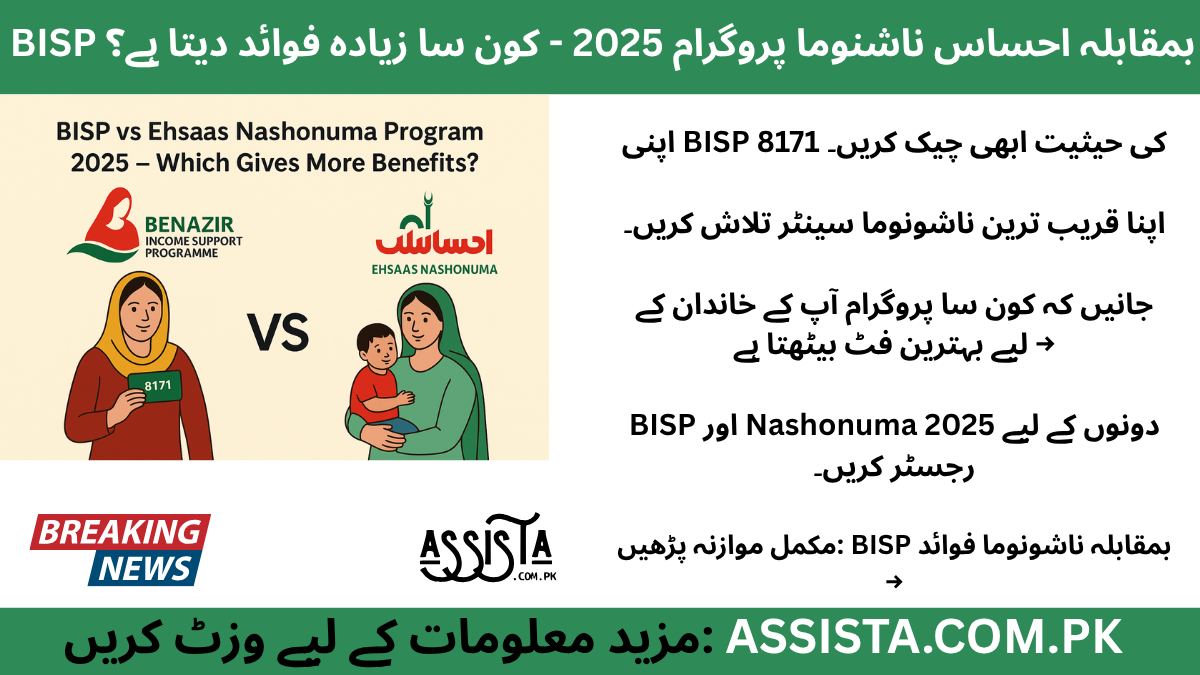
BISP vs Ehsaas Nashonuma Program 2025 – Learn which offers better benefits, cash vs nutrition support, and how families can secure a brighter future.
Introduction – Understanding BISP & Ehsaas Nashonuma
Across Pakistan, government welfare isn’t a headline — it’s survival. From small towns in Sindh to mountain villages in Gilgit-Baltistan, millions of low-income families depend on monthly stipends to buy food, medicine, and school supplies.
Two major pillars stand behind this support: the Benazir Income Support Programme (BISP 8171) and the Ehsaas Nashonuma Program. At first glance they look similar, but in truth they target two very different needs.
BISP 8171 focuses on financial stability — providing quarterly cash transfers to poor households verified through the national poverty score (PMT).
Ehsaas Nashonuma, on the other hand, fights child malnutrition by giving both money and nutrition supplements to mothers and children under five.
Understanding the contrast between these programs helps families choose wisely and maximize benefits. As one mother from Multan told me, “BISP keeps our kitchen running, but Nashonuma keeps my baby healthy.” That single line captures why this comparison matters in 2025 more than ever.
Both initiatives now fall under the umbrella of the Poverty Alleviation and Social Safety Division (PASSD) — meaning Pakistan’s welfare network is more connected than before. Still, each program has unique goals, methods, and outcomes.
Let’s explore how they actually work on the ground.
Program Overview – Two Paths, One Goal
The government designed BISP and Ehsaas Nashonuma to complement each other rather than compete. Both target poverty reduction, but they address it through different doors: income and nutrition.
BISP 8171: Empowering Households Through Cash
Launched in 2008 and expanded yearly, BISP remains Pakistan’s largest social protection scheme. As of 2025, more than 9 million families receive quarterly stipends of around Rs 10,500.
The program ensures payments go directly to the female head of household, empowering women and improving spending transparency. Beneficiaries withdraw funds using the BISP Kafalat Card or authorized 8171 ATMs and payment centers.
BISP’s strength lies in its simplicity — regular cash, fewer conditions, and wide national coverage. For most families, it’s the lifeline that keeps rent paid and stoves lit.
“Every three months when that message from 8171 arrives, we breathe again,” says Shazia, a widow from Okara, recalling how her stipend helps buy rice and medicine.
Ehsaas Nashonuma: Nourishing the Next Generation
Introduced later under the Ehsaas framework, Nashonuma directly tackles child stunting and maternal malnutrition — two silent crises in Pakistan.
The program supports pregnant and lactating women and children under five, offering a mix of:
- Monthly stipends (Rs 2,000 – 2,500 per beneficiary)
- Nutrition supplements and fortified food
- Regular health check-ups at Nashonuma Centers inside DHQ hospitals
- Awareness sessions on breastfeeding, hygiene, and balanced diet
It’s not just about handing out cash — it’s about building healthier generations. Each mother visits the center monthly, the child is weighed, and growth data is recorded. This continuous follow-up makes Nashonuma unique among Pakistani welfare programs.
Eligibility Criteria – Who Qualifies for Each Program
Even though both programs operate under one ministry, their eligibility rules differ to ensure support reaches the right people.
For BISP 8171
- Applicants must belong to a low-income household verified through the National Socio-Economic Registry (NSER) survey.
- The Poverty Means Test (PMT) score must be below the government threshold.
- The female head of family should possess a valid CNIC.
- Families re-verified through the Dynamic Survey 2025 remain eligible for the latest installment.
This structure ensures fairness — those genuinely below the poverty line get prioritized.
For Ehsaas Nashonuma Program 2025
- Children under five years, pregnant, or lactating women can register.
- The household must already exist in the Ehsaas/BISP database.
- The family should live within a designated district where Nashonuma centers are operational.
- CNIC, child B-Form, and basic health documents are required during registration.
Unlike BISP, Nashonuma’s selection focuses on nutrition vulnerability, not just income. A poor household with older children may qualify for BISP but not Nashonuma — and that’s by design.
Ground Reality Example
A farmer’s wife in Thatta shared her story: she receives BISP payments but recently joined Nashonuma for her two-year-old daughter. “Before this program, my child was weak and underweight. Now, after two months of visits and supplements, she’s eating properly,” she said. Her experience proves that targeted aid works when properly implemented.
Payment & Benefits Comparison – Cash vs Care
Here’s where the real difference becomes visible — in the type and quality of benefits each program provides.
| Feature | BISP 8171 | Ehsaas Nashonuma Program |
|---|---|---|
| Main Objective | Income support for poor households | Nutrition support for mothers & children |
| Payment Type | Cash transfer every 3 months | Monthly stipend + supplements |
| Amount (2025) | Rs 10,500 per quarter | Rs 2,000–2,500 per beneficiary per month |
| Delivery Method | ATM, card, or cash center | Health centers at DHQs |
| Extra Services | None (purely financial) | Growth monitoring, medical checkups |
| Target Group | Low-income families | Pregnant/lactating mothers & children < 5 |
BISP Payments – Direct Support
BISP’s strength lies in its digital cash system. Payments are traceable, women-centered, and accessible through 8171 portals. However, the assistance ends once cash is collected; there’s no nutritional or health component.
Nashonuma Benefits – Holistic Health Aid
Nashonuma stands out by merging money with medical support. Each registered mother receives cash only after attending the monthly health session — ensuring she follows the nutrition plan. This smart-conditional model keeps accountability high and impact measurable.
Why It Matters in 2025
Pakistan continues to face high child stunting rates. Pure cash can feed families temporarily, but combining cash with nutrition — like Nashonuma does — builds long-term resilience. Yet, BISP’s broader reach keeps millions afloat every month. In essence, one saves families from hunger today, the other saves children’s futures tomorrow.
Key Takeaway So Far
Both programs are essential, not rivals. BISP 8171 provides economic stability, while Ehsaas Nashonuma 2025 invests in health and human growth. Together, they form Pakistan’s twin engines of social protection.
Application Process – How Families Can Register
While both BISP and Ehsaas Nashonuma belong to the same social protection network, their registration methods are different because their purposes differ.
BISP 8171 Application Process
BISP has made its registration process more digital and easier in 2025. New families are added through the Dynamic Survey, which continuously updates the government’s National Socio-Economic Registry (NSER). Here’s how it works:
- Visit your nearest BISP Tehsil Office or registration camp.
- Provide your CNIC, household details, and income proof (if any).
- Wait for verification via the 8171 SMS system.
- If eligible, you’ll receive a message confirming your enrollment and payment schedule.
Those who are already registered can check their status anytime using the 8171 web portal or by sending their CNIC to 8171.
“It took me just one visit to get verified,” shared a resident from Faisalabad. “After I received the confirmation message, the next installment arrived directly to my BISP card.”
This transparent system prevents misuse and ensures that only verified families receive funds.
Ehsaas Nashonuma Application Process
The Nashonuma program uses a more community-centered registration model. Families don’t need to apply online — they must visit Ehsaas Nashonuma Centers, mostly located inside district or tehsil hospitals (DHQs or THQs).
To register:
- Bring your CNIC, child’s B-Form, and basic health record.
- Health staff will enter your data and open a Nashonuma account.
- You’ll receive a health card/passbook that tracks your child’s growth and cash collection.
Each month, mothers visit the center for a medical checkup and collect their stipend after attendance is verified.
This face-to-face process keeps the program human and accountable. It builds direct trust between mothers and the government — a factor missing in most traditional aid systems.
Coverage & Reach – Where the Programs Operate
Coverage is another major difference between BISP and Ehsaas Nashonuma.
BISP – Nationwide Reach
BISP operates in every district of Pakistan, covering millions of families. From remote Balochistan villages to city centers like Lahore and Karachi, its payment network connects through thousands of ATMs, retail agents, and tehsil offices.
This wide coverage makes BISP the largest welfare program in South Asia by beneficiary count. It’s designed for inclusivity — meaning any Pakistani household meeting the poverty criteria can qualify, regardless of region.
Ehsaas Nashonuma – Focused Expansion
Ehsaas Nashonuma, however, takes a targeted approach. The program started in just 14 districts but now spans over 150+ districts in 2025, especially in regions with high rates of child malnutrition — such as Sindh, KPK, and Gilgit-Baltistan.
These centers are usually located near government hospitals to make healthcare and cash access easy in one place.
For example, in Dera Ismail Khan, a Nashonuma Center inside the DHQ now serves over 2,000 mothers. The staff weigh babies monthly and distribute fortified food to improve growth — something traditional aid programs never managed at this scale.
This difference in reach reflects their strategy:
- BISP = national coverage, financial help.
- Nashonuma = district-focused, health and nutrition help.
Both play complementary roles in Pakistan’s welfare ecosystem.
Advantages of Each Program
Every program has its own strengths, but their benefits often depend on family needs.
Advantages of BISP 8171
- Wide Eligibility: Millions qualify under BISP’s poverty criteria.
- Simple Cash Access: No medical checkups or travel needed — funds go directly to the female head of family.
- Empowers Women: Transfers in women’s names give them decision-making power in household expenses.
- Stable Support: Quarterly installments mean guaranteed assistance every three months.
- Digital Verification: 8171 portal ensures full transparency.
For a daily-wage laborer’s wife in Larkana, BISP means consistent food security. “Whenever prices go up, it’s BISP money that keeps us fed,” she said — a reminder that sometimes, direct cash makes all the difference.
Advantages of Ehsaas Nashonuma
- Dual Benefit: Provides both cash and nutritional supplements.
- Health Monitoring: Continuous baby growth tracking prevents stunting.
- Targeted Impact: Focused on the most vulnerable group — mothers and children under five.
- Education for Mothers: Awareness sessions teach proper diet, breastfeeding, and hygiene.
- Medical Linkage: Every visit connects families to healthcare facilities.
As one mother in Gilgit shared, “Before Nashonuma, I didn’t know my child was underweight. Now I visit every month, and the nurse tells me what food to give.” That small guidance can change an entire generation’s health outcomes.
In short, BISP gives financial stability, while Nashonuma builds human health stability — both essential in a country battling poverty and malnutrition simultaneously.
Limitations to Consider
No government program is perfect, and understanding limitations helps readers set realistic expectations.
Limitations of BISP
- Cash-Only Assistance: It doesn’t provide healthcare, nutrition, or job opportunities.
- Urban-Rural Divide: Access to ATMs or agents is still limited in remote villages.
- Verification Delays: Some families wait months for survey updates or CNIC corrections.
- Awareness Gap: Many eligible women still don’t know how to check their 8171 status online.
BISP’s scope is large, but because it focuses only on income, its long-term impact on health or education remains limited unless families use funds wisely.
Limitations of Ehsaas Nashonuma
- Limited District Coverage: Despite expansion, some rural regions still lack operational centers.
- Restricted Target Group: Only mothers and children qualify — other poor family members remain uncovered.
- Travel Dependency: Families must visit centers monthly, which can be hard for those living far from hospitals.
- Awareness Challenge: Many families think Nashonuma is “just another cash scheme,” not realizing it’s nutrition-based.
Still, for those enrolled, the benefits far outweigh the effort. A single mother from Khairpur explained, “Yes, I travel every month to collect my stipend, but my child’s health is improving — so it’s worth it.”
Key Takeaway (Headings 5–8)
Both BISP 8171 and Ehsaas Nashonuma 2025 have achieved major milestones in reducing poverty and improving public health.
- BISP is broader, simpler, and financially inclusive.
- Nashonuma is targeted, health-focused, and future-oriented.
Together, they form Pakistan’s double engine of welfare — one feeding the table, the other feeding the next generation.
Which Program Truly Helps Families More in 2025?
When we look beyond paperwork and numbers, the real question isn’t just which program pays more, but which one changes lives more deeply.
For Financial Relief: BISP 8171 Wins
For millions of poor families struggling with inflation and unemployment, BISP is the first line of survival.
The cash received every quarter — even if small — means food on the table, school fee paid, or medical expense covered.
“My husband lost work during floods,” shared a woman from Rajanpur. “Without BISP, I would have had to beg or borrow. Now at least I manage every month with dignity.”
This dignity is where BISP wins. It gives women not just money, but a voice in their homes. They become decision-makers, not dependents. That empowerment is often invisible in data but visible in daily life.
So, if the goal is short-term financial security, BISP remains Pakistan’s most reliable program in 2025.
For Long-Term Change: Ehsaas Nashonuma Takes the Lead
Ehsaas Nashonuma, though smaller in scale, addresses the root cause of poverty — poor health and undernutrition. A malnourished child often grows into a less educated and less productive adult. By improving nutrition and early development, Nashonuma is breaking that cycle.
At one Nashonuma center in Swat, nurses keep height and weight records for every baby. Over time, the data showed that children under the program gained more than 30% better growth rates compared to non-enrolled kids.
That’s a generational impact — not just monthly support.
“My daughter used to be weak and sickly,” said a mother in Gilgit. “After the Nashonuma checkups and food, she’s stronger and active. I don’t worry as much anymore.”
In short:
- BISP gives immediate financial relief.
- Ehsaas Nashonuma gives long-term human relief.
So instead of competing, both programs complete each other — one feeds the wallet, the other feeds the future.
Final Verdict – The Future of Pakistan’s Social Protection System
Pakistan’s welfare network in 2025 is stronger than ever before. Both BISP and Ehsaas Nashonuma represent a vision of inclusive growth where no mother, child, or family is left behind.
But the real future lies in integration — when these programs work hand in hand.
Imagine this:
A woman registered under BISP automatically becomes eligible for Nashonuma when she’s pregnant. The cash continues, but now it’s linked with child growth tracking and health awareness. That’s not just welfare — that’s nation-building through social intelligence.
Why This Integration Matters
- It reduces duplication and ensures every rupee is used effectively.
- It transforms temporary relief into sustainable human development.
- It helps the government track progress in real time — using health, education, and poverty data together.
If Pakistan continues this model, it could soon rival the world’s best social protection systems, not in budget size but in impact per rupee.
Real Story That Reflects Both Programs
A woman named Sajida from Khairpur was a BISP beneficiary for two years. When she became pregnant, she was added to Nashonuma through the local hospital.
“Before, I used to spend my BISP cash mostly on food. Now with Nashonuma, they guide me what to eat and give special food for my baby. I feel more supported.”
Her story shows the ideal Pakistan these programs aim for — where financial aid and health support walk together to lift families from survival to stability.
The Bigger Message for 2025
As inflation and unemployment continue to pressure low-income families, Pakistan’s future depends not only on giving money but also on building healthier, more capable generations.
BISP may fill the pockets, but Ehsaas Nashonuma fills the future — and together, they represent a balanced social safety net that focuses on both immediate and long-term human needs.
That’s the path to a more secure, nourished, and self-reliant Pakistan.
Key Takeaway (Headings 9–10)
| Focus | BISP 8171 | Ehsaas Nashonuma |
|---|---|---|
| Main Goal | Financial stability | Child & maternal nutrition |
| Target Group | Low-income families | Pregnant women & children under 5 |
| Payment Cycle | Quarterly cash transfers | Monthly stipends + nutrition |
| Long-Term Impact | Economic inclusion | Health and growth development |
| Strength | Scale and coverage | Targeted, measurable health results |
Both are not rivals — they’re partners in progress. The smart family in 2025 is the one registered in both: receiving financial aid through BISP and health protection through Nashonuma.
Frequently Asked Questions (FAQs) – BISP vs Ehsaas Nashonuma 2025
💬 Top 10 FAQs
1. What is the main difference between BISP and Ehsaas Nashonuma?
The Benazir Income Support Programme (BISP) provides cash assistance to poor families for financial stability, while the Ehsaas Nashonuma Program focuses on improving the nutrition and health of pregnant women and children under five. In short, BISP supports your household income, and Nashonuma strengthens your family’s health — both fighting poverty from different sides.
2. Which program offers better benefits for children?
If your family has young children or infants, then Ehsaas Nashonuma gives more direct benefits. It provides monthly stipends, nutritious food supplements, and regular health check-ups for mothers and babies. BISP helps families manage household costs, but Nashonuma specifically ensures your child grows healthy and strong.
3. Can a family apply for both programs at the same time?
Yes, absolutely. Many families in 2025 are benefiting from both programs together. You can be a BISP Kafalat beneficiary and still enroll in the Ehsaas Nashonuma program if you have children under five or if you’re pregnant or lactating. It’s even recommended — one covers your income, the other covers your health needs.
4. How can I check if I’m eligible for Ehsaas Nashonuma 2025?
You can visit your nearest Nashonuma Center (usually located inside government hospitals or basic health units). Or you can send your CNIC number to 8171 to check your Ehsaas registration. If your record shows eligibility under the Ehsaas database, the local health worker will guide you on how to register for Nashonuma benefits.
5. Are nutrition supplements included in the Ehsaas Nashonuma package?
Yes. Every enrolled mother and child receives nutritional supplements such as fortified food, iron, and vitamins — provided monthly during check-ups. These help prevent stunting and malnutrition, especially in rural areas where diets are limited.
6. Can BISP families switch to Ehsaas Nashonuma instead?
No, these are separate programs — you don’t have to switch. You can stay in BISP Kafalat and add Nashonuma as an extra support program if eligible. BISP gives you quarterly cash, while Nashonuma provides additional nutrition and health support — both can work side by side.
7. How are payments delivered in each program?
For BISP, payments are usually received through 8171 withdrawal centers or ATMs using your Benazir card or CNIC verification. For Ehsaas Nashonuma, payments are made directly at the health center after your regular check-up — mothers receive cash and nutrition on the same visit.
8. Which program covers more regions across Pakistan?
BISP 8171 covers all districts of Pakistan — it’s nationwide. Ehsaas Nashonuma, however, is still targeted to selected high-need districts, mainly in Sindh, KP, Gilgit-Baltistan, and South Punjab, where child malnutrition rates are higher. The government plans to expand it gradually across all provinces by 2026.
9. How often are benefits updated in each program?
BISP payments are reviewed every few months, especially when government budgets are revised or inflation rises. Ehsaas Nashonuma benefits are updated less frequently but include regular nutrition quality checks and growth monitoring every two months to track children’s progress.
10. Where can I find official guidance for both programs?
You can always visit: www.bisp.gov.pk for all Benazir program updates. pass.gov.pk or the official Ehsaas social media pages for Nashonuma information. Avoid fake Facebook pages or WhatsApp messages. Only trust verified government sources or the 8171 SMS system for accurate updates.
Final Word
Both BISP 8171 and Ehsaas Nashonuma Program 2025 are designed to support poor and vulnerable families — one focuses on economic relief, and the other on health and nutrition.
If your home struggles with food security or has small children, enrolling in both programs together gives the best balance of cash support and child well-being.
Stay updated, keep your CNIC verified, and never trust fake messages — Pakistan’s future depends on how well we protect our families today.
Still Confused or Need Help?
If you’re unsure about your eligibility, registration process, or want direct updates from our team — join our official WhatsApp Channel where we share all latest BISP 8171 and government scheme updates step-by-step.
Tap the button below to join our verified WhatsApp channel.
💬 Join WhatsApp ChannelStay updated — we’ll guide you until your BISP or government application process is successfully completed.
Disclaimer / اطلاع برائے عوام
English: This article has been prepared by Saleh Ashraf for public awareness regarding BISP vs Ehsaas Nashonuma Program 2025 – Which Gives More Benefits for a Better Future?. It is not officially affiliated with the Benazir Income Support Programme (BISP) or any government department. For accurate verification, always use the official BISP portal or call the verified helpline 0800-26477.
Roman Urdu (اہم نوٹ): Yeh maloomat sirf public awareness ke liye hai. Is website ka BISP ya kisi hukoomati idaray se koi ta’alluq nahi hai. Apni asal tasdeeq sirf 8171.bisp.gov.pk ya BISP helpline par karein. Kisi bhi WhatsApp message, 03xx number ya fake link par apna CNIC ya personal data share na karein.
Report Fraud: Agar aapko koi suspicious call, SMS, ya fake app mile jo BISP 8171 ka dawa kare, report karein: PTA Complaint Portal, call FIA Cyber Crime (1991), ya apne qareebi BISP Tehsil Office par jaaen.
🔗 Visit Official BISP Website
Saleh Ashraf
Founder of Assista.com.pk
Hi, I’m Saleh Ashraf — a passionate blogger, researcher, and digital educator with over 7 years of experience in blogging, online awareness, and government program analysis. I started Assista.com.pk to help people across Pakistan better understand and benefit from the BISP 8171 Program and other national welfare schemes.
My goal is simple: to make sure every visitor gets clear, verified, and step-by-step guidance about registrations, payments, and updates related to government initiatives. With a strong background in research and content writing, I ensure every article published here is reliable, practical, and genuinely useful for the public.
Beyond BISP 8171, I also share updates on Ehsaas Program, utility relief schemes, and government financial support systems, empowering families to access the help they deserve with confidence and clarity.
📍 Based in Pakistan
💼 Government Awareness Blogger | BISP Program Researcher
🔔 Your trusted source for verified welfare updates and guidance across Pakistan.