Last Updated: November 6, 2025
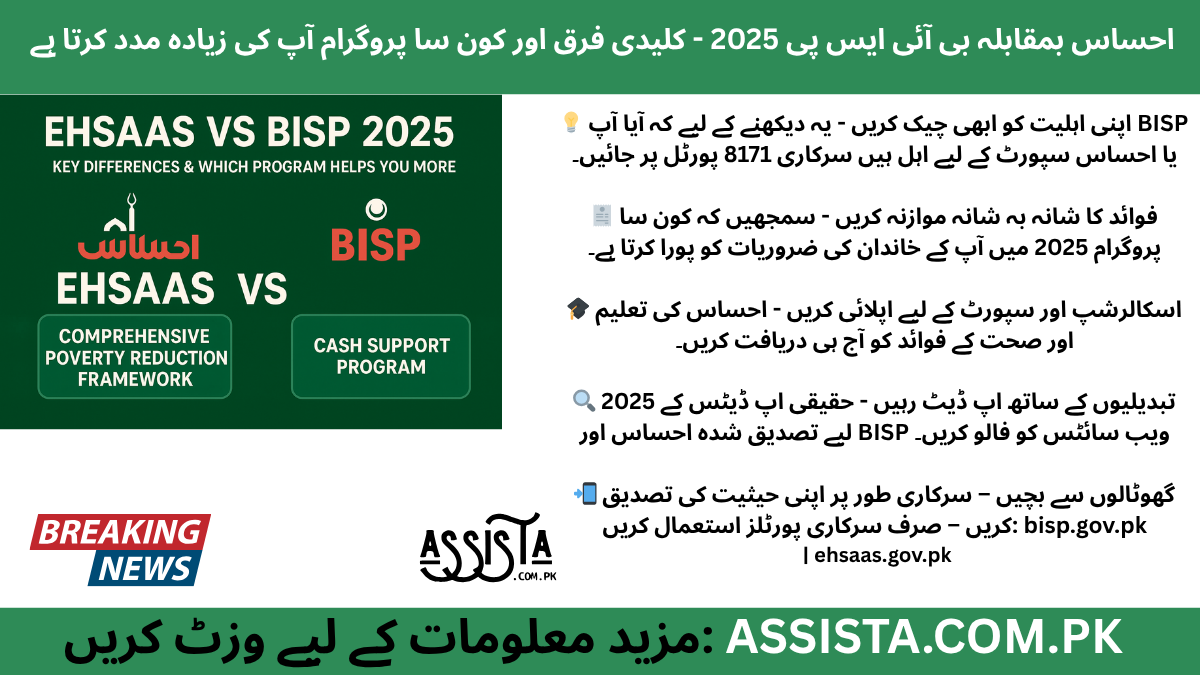
Discover key differences between Ehsaas vs BISP 2025 — eligibility, payments, benefits, and which program empowers Pakistani families more this year.
Understanding the Two Major Programs
In Pakistan, social welfare isn’t just a policy — it’s a lifeline. Millions of families depend on government-run cash programs to survive rising prices, unemployment, and economic pressure. The Benazir Income Support Programme (BISP) and the Ehsaas Program are the two pillars of that safety net, both designed to support low-income households — yet many people still ask: “Which one actually helps more in 2025?”
To understand this, we need to look beyond the names. BISP 8171 was the original poverty-alleviation project introduced to provide direct cash assistance to women from the poorest families. Over time, it became a reliable system for monthly stipends and Kafalat cards. On the other hand, the Ehsaas Program evolved as a broader social protection umbrella, combining dozens of schemes — from education scholarships to health coverage and nutrition programs.
In 2025, both initiatives continue to grow and overlap. Many families qualify for one or both, and confusion remains common. Understanding the key differences, eligibility rules, and benefits coverage helps every household make informed choices.
Story Insight:
Take the example of Shazia Bibi from Bahawalpur. She was a BISP beneficiary for three years, receiving Rs. 6,500 monthly. When Ehsaas expanded in 2024, her daughter became eligible for the Ehsaas Scholarship under the same CNIC. For her, the difference wasn’t just about “which program pays more” — it was about which program created opportunities beyond cash.
Program Overview – Two Paths, One Goal
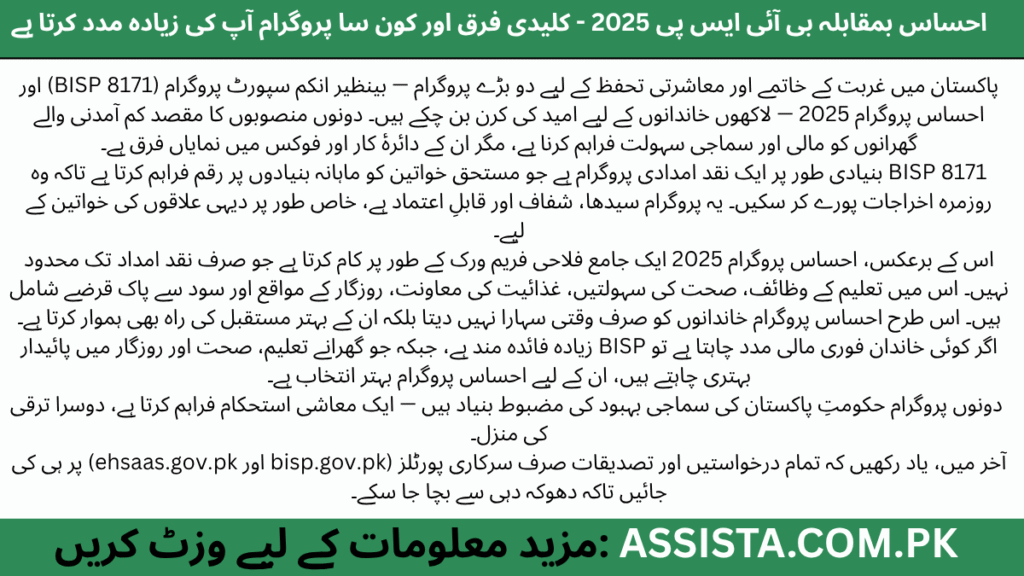
At first glance, BISP 8171 and Ehsaas 2025 appear to do the same thing: give money to poor families. But in structure and purpose, they are very different.
BISP 8171 – The Foundation of Cash Support
The Benazir Income Support Programme was created to give unconditional cash assistance to the poorest 25 percent of households across Pakistan. Its focus is simple — immediate relief. In 2025, BISP continues to disburse payments through Kafalat cards and ATM withdrawals linked to partner banks such as HBL and Bank Alfalah. Beneficiaries are selected through a Poverty Means Test (PMT) survey, ensuring that funds reach genuinely deserving families.
BISP now also includes small-scale support like training initiatives for women and linkages with vocational centers, but its primary mission remains cash delivery — quick, predictable, and transparent.
Ehsaas Program 2025 – Beyond Cash Relief
Ehsaas, launched later under a national poverty framework, took the BISP foundation and expanded it into a full social protection ecosystem. Instead of focusing only on income, it covers education stipends, nutrition support (Ehsaas Nashonuma), health insurance, interest-free loans, and housing initiatives. In 2025, new sub-programs such as Ehsaas Tahafuz (medical support) and Ehsaas Undergraduate Scholarship are running in almost every province.
In short:
- BISP 8171 = Cash support program.
- Ehsaas 2025 = Comprehensive poverty reduction framework.
Both aim to reduce poverty, but Ehsaas tries to break the cycle, while BISP focuses on providing stability.
Mini Example:
A widow in Sukkur receiving Rs. 7,000 monthly under BISP may later enroll her son in an Ehsaas education stipend program. One program sustains the family’s present; the other invests in its future.
Eligibility Criteria Comparison
Eligibility is where most confusion begins, and for good reason — both programs serve poor families, but their selection filters differ.
BISP Eligibility 2025
To qualify for BISP 8171, families must fall below a specific PMT score threshold, usually 32 or below. This score is calculated using the National Socio-Economic Registry (NSER) data, which checks household income, family size, and assets.
Key points:
- Priority is given to female heads of households.
- Families without government employees or property ownership stand a better chance.
- Rural and urban families are both eligible, though coverage in rural areas remains higher.
BISP continues to use SMS 8171 and door-to-door surveys for verification. It’s a focused program — if your household income is extremely low, BISP’s cash support is your starting point.
Ehsaas Eligibility 2025
The Ehsaas Program has a broader definition. It targets multiple categories:
- Low-income families with limited resources.
- Women-headed households seeking empowerment.
- Students needing scholarships.
- Elderly or disabled citizens requiring medical or mobility support.
- Mothers and infants eligible for Ehsaas Nashonuma nutrition stipends.
Eligibility depends on both PMT data and specific sub-program criteria. For instance, a family with a stable monthly income might not qualify for BISP cash support but could still get Ehsaas Education Stipends or Ehsaas Taleemi Wazaif for their children.
Real Story Example:
In Multan, Rahim’s family was not approved for BISP because their PMT score was slightly higher than 32. But when his daughter applied under Ehsaas Undergraduate Scholarship, she received full financial aid for her education. For them, Ehsaas became a bridge of opportunity where BISP couldn’t reach.
Payment & Assistance Types
Both programs deliver financial assistance, but the type, frequency, and conditions vary significantly.
BISP 8171 – Direct Cash Disbursement
- Payment Amount: Usually Rs. 6,000 to Rs. 7,000 per month (2025 rate).
- Delivery Method: Via Kafalat card, ATM, or partner bank branch.
- Frequency: Regular monthly payments after verification.
The goal is simplicity — one account, one family, one monthly payment. Beneficiaries can withdraw through biometric verification to reduce fraud. For many women in rural Sindh and Balochistan, this is their first direct interaction with a financial system, giving them control over household spending.
Ehsaas Program 2025 – Diverse Support Packages
Ehsaas doesn’t limit itself to a single payment model. It provides:
- Conditional Cash Transfers (e.g., stipends linked to school attendance or health checkups).
- Unconditional Cash Grants for the poorest households.
- Education and Scholarship Payments directly to students.
- Nutrition Support for mothers and children under Ehsaas Nashonuma.
- Health and Insurance Support under Ehsaas Tahafuz.
The amounts vary from Rs. 3,000 to over Rs. 40,000 annually depending on the scheme. Payments are usually sent through bank accounts, mobile wallets, or designated centers, ensuring transparency.
Human Angle:
Nasreen Khan, a widow from Khyber Pakhtunkhwa, recalls standing in long queues at ATMs for her BISP stipend. In 2025, when she was enrolled in Ehsaas Tahafuz, her medical bills for surgery were paid directly to the hospital. “One program helped me feed my children,” she said. “The other saved my life.”
Application & Verification Process
Applying for government assistance can feel confusing, especially when both programs—BISP 8171 and Ehsaas Program 2025—seem to overlap. The truth is that each has its own registration system, verification steps, and follow-up method. Knowing these correctly saves beneficiaries from delays, duplicate entries, and fake-agent scams.
BISP 8171 – SMS & Survey-Based Registration
BISP keeps its process straightforward to reach uneducated and rural families.
- Initial Check: Applicants send their CNIC to 8171 by SMS. Within seconds, a response tells whether the family record exists in the database.
- Dynamic Survey: If no record appears, the family is guided to a local BISP registration center where a Poverty Means Test (PMT) is conducted.
- Verification: The data goes to the National Socio-Economic Registry (NSER).
- Approval & Payment Activation: Once verified, the household is issued a Kafalat Card or linked to a partner bank account.
Average verification time: 2–4 weeks, depending on data accuracy and local workload.
Example Insight:
In Chakwal, Fatima sent her CNIC to 8171 and learned her record wasn’t found. After visiting the nearest BISP desk, her survey score qualified her within three weeks. The system may look slow, but it’s designed to favor transparency over shortcuts.
Ehsaas Program 2025 – Online, Biometric & Provincial Channels
Ehsaas, being broader, offers multiple digital paths:
- Online Portal Registration on the Ehsaas website or the official app.
- Field Office Submissions for those without internet access.
- Biometric Verification through NADRA for identity and household validation.
Each sub-program (like Ehsaas Scholarships or Nashonuma) has its own category forms, yet all are linked to the same national database. The process may take 3–5 weeks, but it’s far more integrated and technology-driven.
Human Story:
Salman from Larkana registered for BISP but later applied for Ehsaas Taleemi Wazaif for his two children. Within a month, he received scholarship confirmation via SMS. He called it “the first message that changed my children’s future.”
Benefits Coverage – How Much Each Program Reaches
Both programs promise inclusion, but their coverage style and depth are different.
BISP 8171 – Focused but Targeted
- Geographic Spread: 100+ districts across Pakistan with special focus on Sindh, Punjab South, and Balochistan.
- Family Size Impact: Cash amount is fixed per household—larger families don’t get proportional increases.
- Additional Edge: New 2025 update connects BISP families to Benazir Taleemi Wazaif, allowing school-age children to receive conditional stipends.
BISP’s strength lies in stability—regular, predictable payments even when economic policies change.
Ehsaas 2025 – Broad & Layered Coverage
Ehsaas covers multiple life stages and needs:
- Education: From primary stipends to university scholarships.
- Nutrition: For pregnant women and infants under Nashonuma Program.
- Health: Free medical treatment through Ehsaas Tahafuz.
- Employment Support: Interest-free micro-loans and skill-training grants.
- Geographic Range: Urban, rural, and even remote mountainous regions via provincial collaborations.
So, while BISP ensures monthly cash relief, Ehsaas ensures long-term growth and protection.
Story Glimpse:
In Gilgit, Parveen’s family received BISP payments for three years. When her husband fell ill, the Ehsaas Tahafuz card paid for his hospital care. She said, “BISP fed my family; Ehsaas saved my husband.”
Accessibility & Convenience
Ease of access often determines how beneficial a program feels to ordinary citizens.
BISP 8171 – Traditional but Reliable Access
- Channels: SMS 8171, official portal, and partner bank ATMs.
- Support: Helplines and regional facilitation centers.
- Ground Reality: Many rural beneficiaries still rely on local representatives to interpret messages or help with ATM withdrawals.
Despite limited technology, BISP’s strength is its nationwide presence and the simplicity of SMS verification.
Ehsaas Program 2025 – Digitally Forward
- Digital Tools: Official Ehsaas app, web portal, and NADRA-linked biometrics.
- On-Ground Help: 400+ Ehsaas Centers nationwide providing human assistance.
- User Convenience: Beneficiaries can check eligibility, payments, and application status online—no agent or middleman needed.
For younger or urban families, Ehsaas feels smoother and faster. For older or rural citizens, BISP’s manual approach remains easier.
Mini Case:
In Rawalpindi, a working mother used the Ehsaas app to track her daughter’s scholarship status without leaving her job. Meanwhile, her mother in a village still preferred sending CNIC to 8171.
Different paths, same goal: financial dignity.
Program Transparency & Updates
Transparency is the backbone of trust in any welfare initiative. Both BISP and Ehsaas have invested heavily in digital monitoring and fraud control, especially after public complaints in earlier years.
BISP 8171 – Verified by Data
BISP now integrates with NADRA and NSER to automatically verify CNIC numbers and household data.
- SMS Alerts: Every approved or disqualified household receives automated status messages.
- Complaint Mechanism: Beneficiaries can report fraud through the BISP Complaint Portal or visit regional offices.
- Monitoring: Random household surveys are conducted every six months to keep data updated.
These steps have reduced duplicate payments and fake accounts dramatically since 2023.
Ehsaas Program 2025 – Proactive & Transparent System
Ehsaas operates like a digital ecosystem:
- Each payment or scholarship can be traced through a unique transaction ID.
- Beneficiary Dashboards show disbursement history.
- SMS Updates and mobile notifications alert users of every program revision.
- Independent Audits ensure transparency and accountability.
The result? Faster updates, fewer scams, and higher public confidence.
Real-World Example:
In 2024, a viral fake message claimed “Ehsaas Bonus Grant 20,000 rupees” via a private link. Within hours, the official Ehsaas team posted clarification on social media, saving thousands from fraud. This level of responsiveness is why Ehsaas has earned the reputation of being Pakistan’s most transparent social-welfare system.
Which Program Helps You More? – Choosing Between Ehsaas and BISP 2025
When it comes to real-life impact, the question isn’t just “which program is bigger,” but which one actually fits your situation better. Both Ehsaas and BISP are government-backed initiatives designed to lift low-income families — but they serve different groups and needs.
If your main concern is monthly household survival, BISP Kafalat 2025 might help you more. It directly supports families through regular cash assistance. Thousands of women across rural Pakistan rely on BISP’s Kafalat card — using it for groceries, medicine, or school fees. The process is simple: once verified, the beneficiary receives payments through 8171 or partner banks.
On the other hand, if you want broader, multi-sector support, the Ehsaas Program 2025 offers a more comprehensive package. It includes education scholarships for children, Ehsaas Nashonuma for nutrition, Ehsaas Emergency Cash for crisis support, and even Ehsaas Langar for food security. Families that want long-term development — not just immediate relief — often benefit more from Ehsaas.
Let’s take a real example: Amina, a widow from Multan, was enrolled in BISP Kafalat in 2023 and received consistent payments. But her daughter’s school expenses were growing. When she joined Ehsaas Taleemi Wazaif, she got educational stipends for her daughter, and that changed everything — consistent schooling, no dropouts, and better hope for the future.
So, in short:
- Choose BISP if you want stable monthly cash for household expenses.
- Choose Ehsaas if you want broader help — scholarships, food, and empowerment opportunities.
And yes, some families qualify for both. But the golden rule is: apply through the official portals only and verify your eligibility each year. That ensures you remain active and avoid disqualification during government updates.
Final Advice – Stay Informed & Make the Right Choice
In 2025, social protection programs like Ehsaas and BISP are lifelines — but only for those who stay informed, proactive, and cautious. Pakistan’s digital verification systems (like the 8171 portal) are updated regularly, and beneficiaries must keep their information current to continue receiving aid.
Here’s how you can stay ahead:
✅ Check your eligibility regularly: Use the 8171 web portal or Ehsaas official site to confirm your status. Many families lose payments just because they missed a dynamic survey update.
✅ Respond to dynamic surveys: Whenever BISP staff or Ehsaas teams conduct door-to-door verification, cooperate and provide accurate details. False or outdated data often leads to temporary disqualification.
✅ Avoid fake agents: There are dozens of scams promising faster approval. Remember, both programs are completely free. No agent or person can guarantee payment. Always rely on official messages sent via 8171 or the Ehsaas helpline.
✅ Use official sources for updates:
- https://bisp.gov.pk – For BISP and Kafalat updates
- https://ehsaas.gov.pk – For Ehsaas Program news and registration
Finally, remember — these programs are not just about cash; they’re about restoring dignity. Whether you’re a mother managing a household in Thar or a student in Gilgit trying to fund your education, both Ehsaas and BISP represent hope with accountability.
If you stay alert, verify regularly, and avoid misinformation, you’ll always make the right choice — not just between Ehsaas and BISP, but between uncertainty and empowerment.
FAQs – Ehsaas vs BISP 2025 (User-Intent Focused & Fully Explained)
💬 Top 10 FAQs
1. What is the main difference between Ehsaas and BISP 2025?
The main difference lies in their scope and purpose.
2. Which program provides more cash support?
If you’re looking for consistent monthly payments, BISP Kafalat gives direct cash transfers through 8171. Ehsaas, however, offers conditional or targeted grants, meaning you may receive more in total, but only under certain categories — like scholarships or emergencies. So, for monthly household cash flow, BISP leads, but for total yearly benefits, Ehsaas can go higher depending on your eligibility.
3. Can I apply for both BISP and Ehsaas programs?
Yes — but only if you meet both eligibility criteria. Some families receive BISP support and still qualify for Ehsaas schemes like Ehsaas Taleemi Wazaif or Ehsaas Nashonuma. However, each program has independent verification. Always apply separately through their official portals and never through private agents.
4. How do I check if I am eligible for Ehsaas or BISP?
You can verify eligibility in two simple ways:
5. Which program covers more family members?
BISP usually provides cash assistance per household, not per individual. Ehsaas, however, supports different family members under different categories — for instance, children under Taleemi Wazaif, pregnant mothers under Nashonuma, and the elderly through Ehsaas Kafalat for Senior Citizens. So, Ehsaas covers more members overall, but BISP gives more focused financial relief to the family head.
6. Can I switch from BISP to Ehsaas if eligible?
Technically, you don’t “switch,” but you can apply for Ehsaas programs separately even if you’re already a BISP beneficiary. For example, a woman receiving BISP payments can still register her children for Ehsaas Taleemi Wazaif. Just make sure your CNIC and household data are updated in the NSER database so both systems recognize your eligibility.
7. How often are program benefits updated?
Both programs undergo annual or bi-annual updates. BISP conducts dynamic surveys every few years to reassess eligibility, while Ehsaas introduces new schemes or increases grant amounts based on government budgets. Following official announcements or registering your mobile number ensures you never miss an update.
8. Where can I find official information about both programs?
The safest sources are:
9. The result?
Faster updates, fewer scams, and higher public confidence.
10. Which Program Helps You More?
– Choosing Between Ehsaas and BISP 2025
Still Confused or Need Help?
If you’re unsure about your eligibility, registration process, or want direct updates from our team — join our official WhatsApp Channel where we share all latest BISP 8171 and government scheme updates step-by-step.
Tap the button below to join our verified WhatsApp channel.
💬 Join WhatsApp ChannelStay updated — we’ll guide you until your BISP or government application process is successfully completed.
Disclaimer / اطلاع برائے عوام
English: This article has been prepared by Saleh Ashraf for public awareness regarding Ehsaas vs BISP 2025 – Key Differences & Which Program Empowers You More. It is not officially affiliated with the Benazir Income Support Programme (BISP) or any government department. For accurate verification, always use the official BISP portal or call the verified helpline 0800-26477.
Roman Urdu (اہم نوٹ): Yeh maloomat sirf public awareness ke liye hai. Is website ka BISP ya kisi hukoomati idaray se koi ta’alluq nahi hai. Apni asal tasdeeq sirf 8171.bisp.gov.pk ya BISP helpline par karein. Kisi bhi WhatsApp message, 03xx number ya fake link par apna CNIC ya personal data share na karein.
Report Fraud: Agar aapko koi suspicious call, SMS, ya fake app mile jo BISP 8171 ka dawa kare, report karein: PTA Complaint Portal, call FIA Cyber Crime (1991), ya apne qareebi BISP Tehsil Office par jaaen.
🔗 Visit Official BISP Website
Saleh Ashraf
Founder of Assista.com.pk
Hi, I’m Saleh Ashraf — a passionate blogger, researcher, and digital educator with over 7 years of experience in blogging, online awareness, and government program analysis. I started Assista.com.pk to help people across Pakistan better understand and benefit from the BISP 8171 Program and other national welfare schemes.
My goal is simple: to make sure every visitor gets clear, verified, and step-by-step guidance about registrations, payments, and updates related to government initiatives. With a strong background in research and content writing, I ensure every article published here is reliable, practical, and genuinely useful for the public.
Beyond BISP 8171, I also share updates on Ehsaas Program, utility relief schemes, and government financial support systems, empowering families to access the help they deserve with confidence and clarity.
📍 Based in Pakistan
💼 Government Awareness Blogger | BISP Program Researcher
🔔 Your trusted source for verified welfare updates and guidance across Pakistan.

1 thought on “Ehsaas vs BISP 2025 – Best Key Differences & Which Program Truly Empowers You”