Last Updated: 28 October 2025
Introduction – Why Understanding PMT Score Matters for BISP 8171
The PMT (Poverty Means Test) score is the cornerstone of the BISP 8171 program in 2025. Every household applying for BISP Kafalat or related welfare payments is evaluated based on this score. This means your eligibility, payment priority, and inclusion in future programs are all directly linked to your PMT number.
For many beneficiaries across Pakistan, unawareness or outdated information can result in delayed payments or exclusion. Understanding your PMT score bisp 8171 2025 ensures you know exactly where your household stands, and allows you to correct any discrepancies proactively.
For example, in Rural Punjab, a family of six initially faced delayed payments because their income from a small property was not included. Once the details were updated via the BISP portal, their PMT score dropped, improving their priority for the next payment cycle.
Knowing your PMT score is essential because:
- It clarifies eligibility status.
- Helps prevent payment delays due to incorrect data.
- Enables timely updates for household composition, assets, and income.
In short, understanding your PMT Score in BISP 8171 is the first critical step toward securing your rightful BISP payments in 2025.
Fact 1 – PMT Score in BISP 8171 Is Based on Household Data
The PMT score reflects your household’s overall socioeconomic status. BISP collects information on multiple aspects of your family, which directly impacts your eligibility. Key factors include:
Family Size & Composition
The number of family members, their ages, and dependencies significantly influence your score. Larger households with more dependents usually receive a lower score, giving them higher payment priority. For example, a household with six members, including school-aged children and a student son in college, will naturally be considered higher need compared to a smaller household with fewer dependents.
Income Level & Assets
All forms of income—including salaries, business earnings, property rent, and livestock—are included in PMT calculations. Accurate reporting is crucial: missing or incorrect information can inflate your score, lowering your payment priority. A small rented property or vehicle, if unreported, can affect your score significantly.
Education & Employment Status
Household members’ education and employment also influence the PMT score. Educated and employed members indicate financial stability, which may increase your score slightly and reduce immediate payment priority. For instance, a father employed in a government office and a son working part-time may see a slightly higher score than households without formal income sources.
By combining all these factors, the PMT system ensures fairness, prioritizing households with genuine need. The example from Rural Sindh, where a missing property update initially inflated the score, illustrates why keeping household data accurate is essential.
Fact 2 – Higher PMT Score in BISP 8171 Means Lower Payment Priority
The PMT score is generally measured on a 0–100 scale:
- 0–30: Highest priority for BISP Kafalat payments.
- 31–50: Medium priority; payments may be slightly delayed.
- 51+ : Lower priority; payments can be delayed and flagged for verification.
In essence, a higher score signals better financial stability, while a lower score indicates urgent need. Thresholds are updated periodically by BISP based on survey data and regional requirements. For example, after the 2024–25 survey in Southern Punjab, households affected by floods received adjusted thresholds, giving them priority even with a slightly higher PMT score.
Practical cases from Karachi’s informal settlements show how important monitoring is. A family with an initial PMT score of 48 experienced delayed payments. After updating their household income and property details through the official 8171 SMS service, the score dropped to 39, and payments were processed in the next cycle.
This demonstrates that the PMT score is dynamic, not static. Accurate and updated data ensures your household remains high-priority for payments, while errors or omissions can result in delays or lower priority.
Fact 3 – Dynamic Survey Updates PMT Score in BISP 8171
The dynamic survey is BISP’s method of re-verifying household data every 1–2 years. Its purpose is to ensure that households continue to meet eligibility requirements and that payments are fairly distributed.
Why the Dynamic Survey Matters
- Accuracy: Confirms that reported income, assets, and family composition are up-to-date.
- Eligibility Protection: Households with outdated or incorrect info may see their PMT score increase, reducing payment priority.
- Future Inclusion: Ensures households remain eligible for special BISP programs or emergency assistance.
For example, in Rural Khyber Pakhtunkhwa, a family initially had a PMT score of 45. The dynamic survey revealed a son’s part-time income and unreported assets. After updating the information, the score adjusted to 42, improving their payment priority.
Beneficiaries are encouraged to participate actively in the dynamic survey, providing accurate details of:
- Family members’ age, education, and employment status
- All sources of income
- Assets including property, vehicles, and livestock
Failing to update any of these can lead to higher PMT scores and delayed payments, as BISP relies on verified data for its calculations.
Fact 4 – Income Verification Directly Impacts PMT
One of the most critical factors in PMT score bisp 8171 2025 is income verification. BISP relies on official income data, such as salaries, business earnings, and property rental income, to calculate accurate scores.
How It Works
- Salary & Business Income: Any formal employment or business income is submitted via official documents.
- Property & Assets: Rental income, vehicles, and livestock are also considered.
- Documentation: Proper proofs, like salary slips or rental agreements, ensure your PMT score reflects your real household situation.
For example, a family in Lahore reported only the father’s salary initially. The mother’s small tailoring income was unreported. This resulted in a slightly lower PMT score than actual. After submitting income proof for both parents, the PMT score updated, reflecting their accurate household profile.
Tip: Misreporting or omitting income can delay payments or even temporarily block eligibility. Always submit verified income documents to maintain correct PMT status.
Fact 5 – PMT Score in BISP 8171 Is Transparent and Trackable
BISP has made PMT score transparency a priority. Beneficiaries can now track their PMT score via the BISP portal or 8171 SMS service, ensuring that no household is unfairly excluded.
Ways to Track PMT Score
- BISP Portal: Enter your CNIC and date of birth to view detailed household data, assets, and PMT score.
- SMS 8171: A simple CNIC-based query provides your current score and payment status.
- Alerts & Updates: BISP sends SMS notifications if your data is verified or updated.
For instance, in Karachi, a beneficiary noticed an unexpectedly high score of 50 via SMS 8171. After reviewing her data on the portal, she realized that a recently married daughter was missing from the household record. Once corrected, her PMT score dropped to 43, ensuring timely payments.
This shows that PMT score monitoring is crucial. Beneficiaries should routinely check their score and report discrepancies immediately to avoid payment delays.
Step-by-Step: How to Check Your PMT Score in BISP 8171
Checking your PMT score is simple if you follow the official steps. This ensures your eligibility status is always up-to-date.
Step 1 – Visit BISP Portal
Go to bis.gov.pk and navigate to the Eligibility / PMT Score section.
Step 2 – Enter Your CNIC and Date of Birth
Provide your 13-digit CNIC and date of birth exactly as registered with NADRA. Accuracy here is crucial.
Step 3 – Review Household Details
Check:
- Family composition
- Reported income
- Assets and properties
- Education and employment status of members
Step 4 – Report Discrepancies
If you notice missing members, incorrect income, or outdated property info, immediately report through the portal or 8171 SMS service.
Example from Rural Sindh
A household initially reported 5 members; however, a dependent cousin was living with them. After updating the family composition, their PMT score dropped from 46 to 41, improving payment priority.
Pro Tip: Always save screenshots or SMS confirmations after any update to ensure you have proof in case of future discrepancies.
Common PMT Score in BISP 8171 Mistakes to Avoid
Several errors commonly affect PMT score bisp 8171 2025, leading to payment delays or low priority. Beneficiaries must be vigilant.
Mistake 1 – Wrong CNIC or Family Data
Entering an incorrect CNIC or missing household members can inflate your PMT score or disqualify you. Always verify each family member is accurately listed.
Mistake 2 – Ignoring Dynamic Survey Updates
Skipping dynamic survey participation can leave your PMT score outdated. This may result in delayed or blocked payments.
Mistake 3 – Not Submitting Proper Income Documentation
Even small incomes from part-time work, property rent, or informal business must be reported. Missing documentation can increase your PMT score, reducing payment priority.
Mistake 4 – Failing to Update Address or Phone Number
BISP often communicates via SMS 8171. Outdated contact info means missing alerts about discrepancies or required verification, potentially delaying payments.
Real-Life Example
A family in Rural Khyber Pakhtunkhwa had an old CNIC linked to the mother, who recently moved. Payments were delayed because SMS notifications didn’t reach them. Once they updated CNIC and address, PMT score verification proceeded, and payments resumed.
By avoiding these mistakes and regularly checking your PMT score, you ensure accurate eligibility, timely payments, and priority status.
How PMT Score in BISP 8171 Affects Your Payment & Eligibility
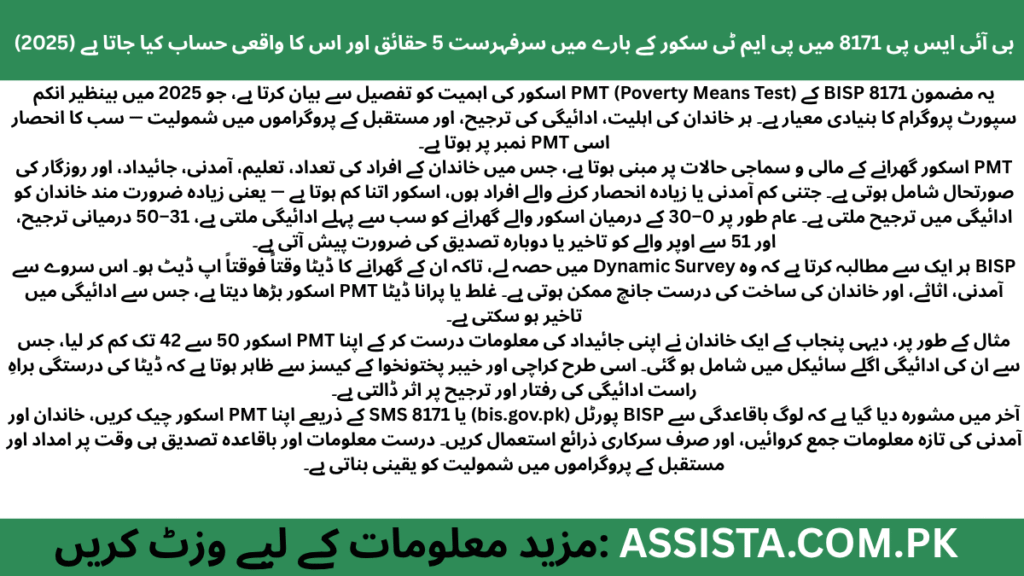
The PMT score bisp 8171 2025 is not just a number—it directly influences monthly BISP payments, re-verification flags, and eligibility for special programs. Understanding its effect can save households from unnecessary delays or exclusions.
1. Determines Payment Amount & Priority
- Lower score (0–30): Highest priority for monthly payments. Beneficiaries receive timely assistance.
- Medium score (31–50): Payments may be slightly delayed depending on funds availability.
- High score (51+): Lower priority; payments may require additional verification before release.
For instance, in Rural Sindh, a family initially had a score of 48. Payments were delayed until updated household and income details lowered the score to 42, ensuring their inclusion in the next payment cycle.
2. Flags Accounts for Re-Verification
High PMT scores can trigger re-verification, requiring submission of updated documents for income, assets, or family composition. This ensures fair distribution and prevents misuse of funds.
3. Impacts Inclusion in Future Programs
BISP often runs special assistance programs for flood-affected areas, women empowerment schemes, or emergency support. Only households with verified PMT scores and updated data are considered eligible.
Example: In Karachi informal settlements, a household with a previously outdated PMT score missed the special winter assistance program. After updating their household and income data, they were included in the next emergency aid program, illustrating why timely PMT score management is crucial.
Tip: Regularly check your PMT score and participate in surveys to maintain your household’s eligibility and ensure priority payments.
Final Advice – Stay Updated and Verify Your Score Regularly
Maintaining an accurate PMT score is key to uninterrupted BISP benefits. Following these steps ensures your household stays eligible and prioritized:
1. Monitor PMT Score Frequently
Check your score at least once every few months through:
- BISP Portal: For detailed household, income, and asset verification
- SMS 8171: For quick updates and alerts
2. Update Family, Income, and Household Info
- Add newly married or newborn family members
- Report any new income sources or assets
- Correct any previously missing or wrong data
Example: A household in Rural Punjab added a son’s part-time income and updated property ownership, which reduced their PMT score from 50 to 42, significantly improving payment priority.
3. Use Official Channels Only
Avoid third-party services. Always rely on:
- BISP portal (bis.gov.pk)
- SMS 8171 service
These channels are secure and provide official proof of updates and score changes.
4. Participate in Dynamic Surveys
BISP’s dynamic surveys re-verify data every 1–2 years. Participation ensures your score reflects the real household situation, and helps avoid delays or payment rejection.
5. Correct Mistakes Promptly
- Wrong CNIC
- Missing family members
- Outdated income or asset information
Reporting errors immediately ensures continuous eligibility and priority for payments.
Real-Life Example: A family in Karachi noticed a high PMT score due to an unreported dependent daughter. After correcting the information via SMS 8171, their score improved, and they received timely payment in the next cycle.
FAQs – PMT Score BISP 8171 2025
BISP PMT Score 2025 – FAQs
Complete guide to understanding and managing your PMT score for BISP payments
This FAQ provides comprehensive information about the PMT (Poverty Means Test) score system used by BISP to determine eligibility and payment priority for beneficiaries.
📊 PMT Score Scale: 0-100
Lower scores indicate higher need and faster payment processing
The PMT score is a numeric value (0–100) assigned to households by BISP to determine eligibility and payment priority.
Key Points:
- Lower scores indicate higher need and faster payments
- Higher scores may result in delayed payments
- Scores are calculated based on verified household data
- Regular updates ensure accurate scoring
BISP calculates the score based on multiple factors:
Yes! Multiple ways to check your PMT score:
PMT score updates occur:
- Every 1–2 years through dynamic surveys
- When beneficiaries submit verified updates
- After major household changes
- During annual re-verification cycles
The dynamic survey re-verifies household information and directly impacts your PMT score:
- Missing information: Can increase your PMT score
- Outdated data: Lowers payment priority
- Correct updates: Ensure accurate ranking
- Complete participation: Maintains score accuracy
Yes. Inaccurate information can negatively impact your score:
- Misreporting income
- Omitting assets
- Incorrect employment status
- Outdated family composition
The PMT score directly influences:
- Payment Amount: Lower scores often receive higher amounts
- Payment Priority: Lower scores = higher priority
- Verification Requirements: Higher scores may need additional verification
- Payment Timing: Scores affect disbursement schedules
Take immediate action if you suspect score inaccuracies:
- Report discrepancies via BISP portal or SMS 8171
- Submit correct documents for verification
- Update income, assets, or household changes
- Monitor updates to ensure accuracy
- Contact BISP helpline for assistance
Yes. Family size significantly impacts PMT scoring:
- Larger families with more dependents usually have lower scores
- More dependents typically indicate higher financial need
- Family composition affects overall household assessment
- Accurate family data ensures proper score calculation
Maintain score accuracy through these practices:
- Regularly check your score via portal or 8171 SMS
- Participate actively in dynamic surveys
- Submit updated household information promptly
- Report income and asset changes immediately
- Keep family composition records current
- Respond to verification requests quickly
Official BISP Support Channels
- Website: bisp.gov.pk
- SMS: Send CNIC to 8171
- Helpline: 0800-26477
- Mobile App: Official BISP App
Key Takeaways
- PMT score is the foundation of BISP 8171 eligibility—lower score = higher priority.
- Household data accuracy matters: family size, income, education, employment, and assets all influence your score.
- Dynamic surveys and income verification keep your PMT score up-to-date and ensure fair payments.
- Regular monitoring via portal or 8171 SMS prevents delays or missed payments.
- Mistakes or outdated info can raise PMT score and reduce payment priority—correct immediately.
Example: A Rural Punjab household dropped their PMT score from 50 to 42 after updating income and family data, ensuring timely payment in the next cycle.
Final Notes / Advice
- Stay proactive: Regularly monitor your PMT score and check for discrepancies.
- Use official channels only: BISP portal (bis.gov.pk) and SMS 8171 are secure, official sources.
- Update household and income details: Accurate reporting prevents delays and keeps priority high.
- Participate in dynamic surveys: Every 1–2 years to maintain eligibility.
- Keep documentation ready: CNICs, income proofs, and asset documents for any verification.
Following these steps ensures continuous eligibility, priority payments, and inclusion in future BISP programs.
Still Confused or Need Help?
If you’re unsure about your eligibility, registration process, or want direct updates from our team — join our official WhatsApp Channel where we share all latest BISP 8171 and government scheme updates step-by-step.
Tap the button below to join our verified WhatsApp channel.
💬 Join WhatsApp ChannelStay updated — we’ll guide you until your BISP or government application process is successfully completed.
Disclaimer / اطلاع برائے عوام
English: This article has been prepared by Saleh Ashraf for public awareness regarding Top 5 Essential Facts About PMT Score in BISP 8171 & How It’s Really Calculated (2025). It is not officially affiliated with the Benazir Income Support Programme (BISP) or any government department. For accurate verification, always use the official BISP portal or call the verified helpline 0800-26477.
Roman Urdu (اہم نوٹ): Yeh maloomat sirf public awareness ke liye hai. Is website ka BISP ya kisi hukoomati idaray se koi ta’alluq nahi hai. Apni asal tasdeeq sirf 8171.bisp.gov.pk ya BISP helpline par karein. Kisi bhi WhatsApp message, 03xx number ya fake link par apna CNIC ya personal data share na karein.
Report Fraud: Agar aapko koi suspicious call, SMS, ya fake app mile jo BISP 8171 ka dawa kare, report karein: PTA Complaint Portal, call FIA Cyber Crime (1991), ya apne qareebi BISP Tehsil Office par jaaen.
🔗 Visit Official BISP Website
Saleh Ashraf
Founder of Assista.com.pk
Hi, I’m Saleh Ashraf — a passionate blogger, researcher, and digital educator with over 7 years of experience in blogging, online awareness, and government program analysis. I started Assista.com.pk to help people across Pakistan better understand and benefit from the BISP 8171 Program and other national welfare schemes.
My goal is simple: to make sure every visitor gets clear, verified, and step-by-step guidance about registrations, payments, and updates related to government initiatives. With a strong background in research and content writing, I ensure every article published here is reliable, practical, and genuinely useful for the public.
Beyond BISP 8171, I also share updates on Ehsaas Program, utility relief schemes, and government financial support systems, empowering families to access the help they deserve with confidence and clarity.
📍 Based in Pakistan
💼 Government Awareness Blogger | BISP Program Researcher
🔔 Your trusted source for verified welfare updates and guidance across Pakistan.