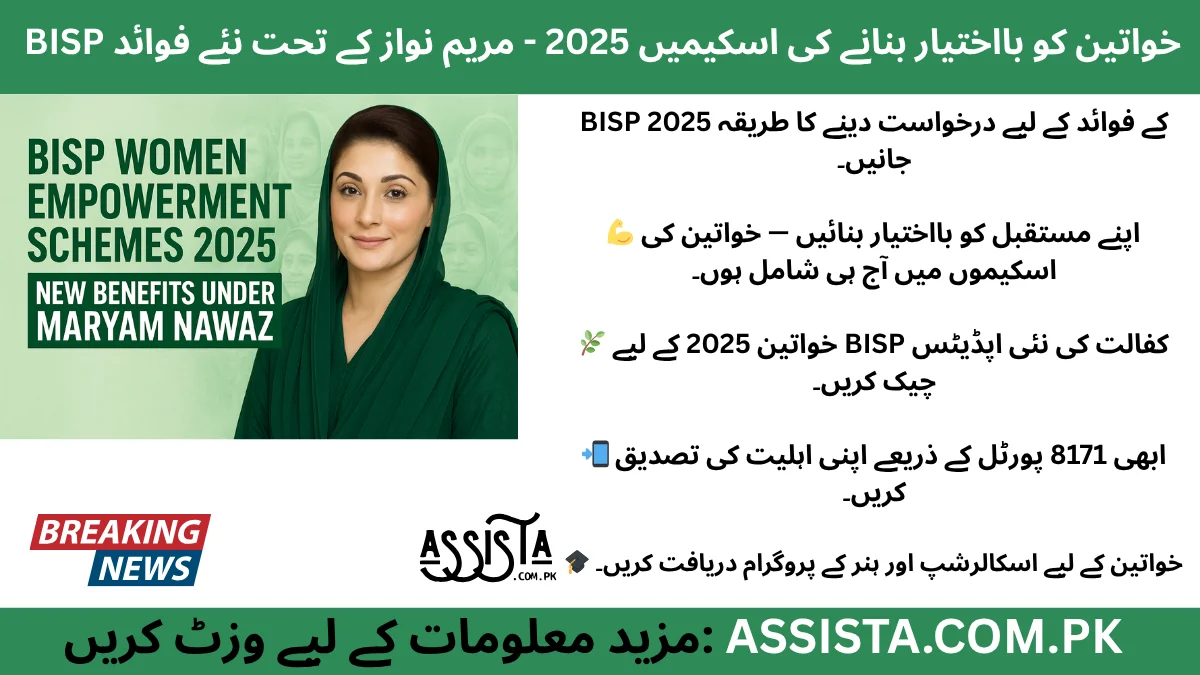
Discover how BISP Women Empowerment Schemes 2025 empower Pakistani women with cash aid, education, and skill programs under Maryam Nawaz’s vision.
Introduction – Empowering Women Through BISP
Across Pakistan, millions of women are rewriting their stories — not through charity, but through empowerment. The Benazir Income Support Programme (BISP), once known only as a welfare aid initiative, has now evolved into a true force for women’s independence under the leadership of Maryam Nawaz Sharif in 2025.
For years, BISP provided basic financial relief to struggling households. But 2025 marks a clear turning point — where cash support meets skill development, education, and dignity. The government’s new phase, officially known as the BISP Women Empowerment Schemes 2025, focuses on turning beneficiaries into earners and learners.
Maryam Nawaz’s vision is simple yet powerful: “Every Pakistani woman should not only survive — she should thrive.” This vision reflects directly in the new programs that target women from every corner of the country — from a mother in Vehari managing her home with limited means, to a young woman in Skardu learning IT freelancing through a BISP training center.
This article explores how these new schemes are transforming female empowerment in Pakistan — covering cash assistance, educational support, and skill-building opportunities, all designed to make women financially confident and socially respected.
Overview of Women Empowerment Schemes 2025
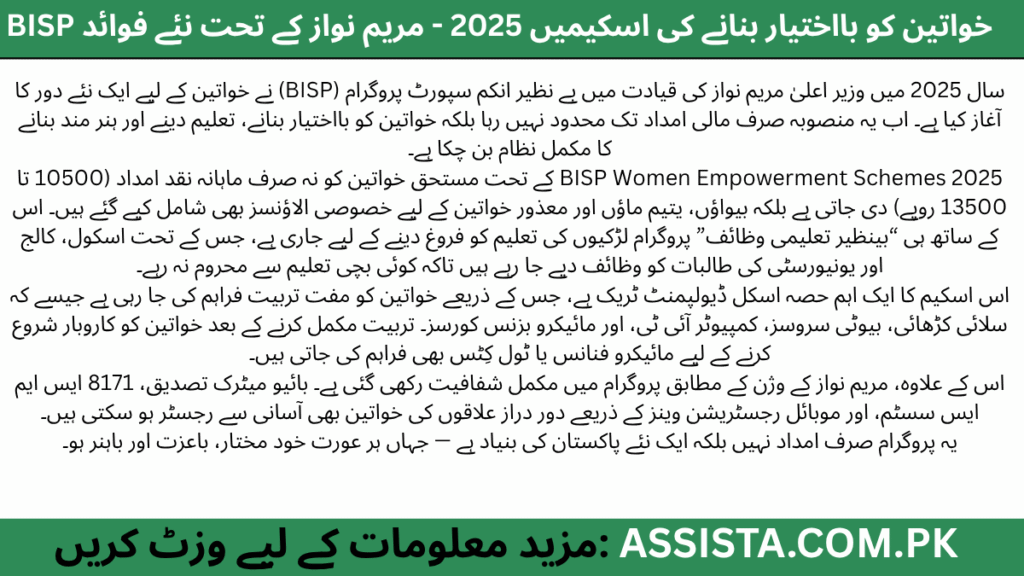
The BISP Women Empowerment Schemes 2025 are not just about financial transfers — they represent a structured ecosystem of opportunity. Each initiative addresses a different layer of women’s development, ensuring that empowerment is not temporary but lifelong.
a. Cash Assistance (Kafalat Program)
At the foundation lies the Benazir Kafalat Program, which continues to provide quarterly stipends ranging from Rs. 10,500 to Rs. 13,500 to eligible women. However, the 2025 update brings special allowances for widows, single mothers, and differently-abled women, ensuring that no vulnerable group is left behind.
For instance, Shazia from Khairpur used her Kafalat payment to start a small embroidery setup at home. What began as simple household support is now her primary income source. Stories like hers prove that financial aid, when paired with training, becomes empowerment in action.
b. Education & Scholarships for Girls
Recognizing that empowerment begins with education, BISP now extends Benazir Taleemi Wazaif scholarships to girls at primary, secondary, and higher education levels. The stipend amount ranges from Rs. 3,000 to Rs. 4,500 per child per quarter, helping mothers keep their daughters in school.
Beyond school stipends, a new “Education Plus” initiative under Maryam Nawaz’s direction supports girls pursuing college education — an unprecedented move for a federal welfare program.
c. Skill Development & Entrepreneurship
The most promising addition is the Women Skill Development Track, where beneficiaries receive free training in vocational and digital skills. Partnering with institutions like NAVTTC, TEVTA, and PSDF, BISP now offers certified training in tailoring, beauty services, handicrafts, computer literacy, and micro-entrepreneurship.
The goal is not just to distribute money but to build the capability to earn. Women completing these courses can access micro-finance facilities or receive toolkits to start small businesses at home.
Eligibility Criteria for Female Beneficiaries
BISP has always prioritized women, but the 2025 schemes come with more clarity, transparency, and fairness. To ensure that support reaches those who truly need it, every applicant must meet certain conditions verified through the National Socio-Economic Registry (NSER) and Dynamic Survey.
Who Can Apply
- Must be a female head of household or a primary guardian of children.
- Must possess a valid CNIC verified by NADRA.
- The family’s Poverty Means Test (PMT) score must be below 32.
- Must have completed or updated the Dynamic Survey in the last cycle.
Widows, divorced women, and women with disabled dependents are given special consideration during screening.
Verification & Transparency
The 2025 process introduces biometric verification at registration and payment stages — ensuring no misuse or duplication. Additionally, applicants receive SMS alerts via 8171 for every approval, payment, or update, reducing reliance on middlemen.
Maryam Nawaz’s administration has also launched mobile registration vans, especially in rural Punjab and interior Sindh, allowing women from remote areas to register at their doorstep — a small step that has made a huge difference in inclusion.
For example, Nasreen from Dera Ghazi Khan couldn’t travel to the Tehsil office due to illness. The mobile unit helped her complete her survey, and within two weeks, she received confirmation of her eligibility. This kind of accessibility shows how deeply the 2025 model prioritizes women’s ease and respect.
Cash Assistance Benefits
The cash assistance segment under the BISP Women Empowerment Schemes 2025 remains the backbone of the program, but now it carries new layers of practicality and fairness.
Regular Support for Stability
Eligible women continue receiving Rs. 10,500 to Rs. 13,500 quarterly through their Benazir Kafalat card or partner banks. The funds are meant for essentials — food, education, medicine, and small home-based expenses. The steady cash flow gives families breathing space, especially in rising inflation.
Special Categories
The 2025 revision added extra support for vulnerable groups:
- Widows and single mothers get a top-up allowance for dependents.
- Disabled women receive a separate cash bonus along with access to specialized training.
- Flood-affected women from Sindh and Balochistan are eligible for temporary relief packages linked with the empowerment fund.
Integration with Other Welfare Programs
To create a connected support ecosystem, BISP has started linking beneficiaries with Ehsaas Taleemi, Punjab Rozgar Scheme, and Women Chambers of Commerce. This integration allows women to move beyond passive aid and enter the mainstream economy.
For instance, Farzana from Bahawalnagar began receiving her Kafalat stipend in 2024. Through BISP’s coordination with NAVTTC, she joined a beautician training course and now earns up to Rs. 18,000 a month from home. That’s what empowerment looks like — a journey from aid to ability.
Digital Transparency
To prevent fraud and ensure smooth payment, all disbursements are digitally traceable. Beneficiaries receive SMS confirmations, and the online BISP 8171 portal allows tracking of both cash payments and skill development progress.
This hybrid model — financial support plus digital empowerment — is what makes the BISP women benefits 2025 scheme a landmark in Pakistan’s social welfare history.
How to Reapply After BISP Rejection (Step-by-Step Recovery Plan)
If your BISP application was rejected, don’t lose hope — most cases can be fixed. The truth is, rejection doesn’t mean you’re permanently disqualified; it usually means there’s a missing detail or verification issue. Here’s how you can turn that “Rejected” status into “Approved” step by step:
Step 1 – Verify Your CNIC Again
Visit the NADRA office or send your CNIC number to 8171 again. Sometimes old or unverified CNIC data triggers an automatic rejection. A simple re-verification often resolves this.
Step 2 – Update Family Information
If your family details changed (for example, marriage, child birth, or death in family), update them at the nearest BISP Tehsil Office. The system matches family data with NADRA’s database, and any mismatch can block your approval.
Step 3 – Recheck Poverty Score
Your PMT (Proxy Means Test) score decides your eligibility. If your income or assets have changed, your score can shift. Ask the representative at the BISP office to show your PMT record. If it’s above 32, request for re-evaluation.
Step 4 – Submit Reapplication with Corrected Info
Once you’ve corrected all details, fill out the BISP registration form again or apply online through the official 8171 portal. Make sure your CNIC, address, and mobile number are exactly as per NADRA records.
Step 5 – Keep Checking Status Regularly
Use the 8171 Web Portal or SMS “CNIC” to 8171 every 15 days. Once your record is updated in the system, approval usually follows within one or two payment cycles.
Pro Tip:
Many people in Punjab and Sindh who faced “record not found” errors fixed their cases just by re-verifying their CNIC and updating family info — it’s simple but powerful.
Real Stories: How Pakistani Families Got Approved After Rejection
To understand this better, let’s look at real stories from the ground — people who didn’t give up after being rejected.
Example 1 – The Case of Shazia from Multan
Shazia, a widow with two children, got rejected in 2024 because her CNIC record showed an incorrect address. When she visited the local BISP Tehsil Office and corrected it through NADRA, her application got approved in the very next cycle. Today, she receives Rs. 10,500 every quarter and says, “Mujhe laga system corrupt hai, lekin asal mein meri file incomplete thi.”
Example 2 – Tariq from Gilgit-Baltistan
Tariq’s family was disqualified due to “income mismatch.” After reviewing his PMT score, he found out that an old bank account in his name was causing the issue. Once he closed that inactive account and submitted an affidavit, his eligibility was restored.
Example 3 – Bushra from Larkana
Bushra’s case was rejected twice — she finally discovered that her husband’s CNIC was still registered as “active taxpayer,” even though he was unemployed for two years. After clearing that with FBR, her BISP payments started flowing again.
These stories show one thing clearly: BISP isn’t unfair — it’s strict on data. And those who fix their data problems almost always get back in.
Common Myths About BISP Rejections You Should Stop Believing
Over time, hundreds of false rumors have spread about BISP — and they confuse genuine applicants. Let’s clear the most common myths once and for all:
Myth #1 – “Once Rejected, Always Rejected”
False. You can reapply after correcting your information. Thousands of families re-entered successfully after verification.
Myth #2 – “Agents Can Approve Your Case Faster”
Completely untrue. Only official BISP offices and the 8171 system decide eligibility. Paying agents is risky — you could lose your money and still stay rejected.
Myth #3 – “You Must Be Politically Connected”
No, BISP works on poverty data, not politics. The entire eligibility process is based on NADRA’s PMT score, not recommendations.
Myth #4 – “People in Cities Can’t Qualify”
Wrong again. Even urban low-income families qualify if they meet the income and property criteria. Many approved beneficiaries live in Karachi, Lahore, and Rawalpindi.
By knowing the truth behind these myths, you protect yourself from manipulation and focus only on authentic steps that actually work.
Key Documents You Need for a Successful Reapplication
Before visiting the office or portal again, prepare all the right documents. Missing just one can delay your approval for months.
Essential Documents Checklist:
- Original CNIC of the applicant (and spouse if married)
- Family Registration Certificate (FRC) from NADRA
- Children’s B-Forms (if applicable)
- Proof of income or unemployment (if available)
- Electricity or gas bill for address confirmation
- Old BISP or Ehsaas reference number (if reapplying)
Bonus Tip:
Keep two photocopies of each document — one for submission and one for your record. Sometimes field officers misplace forms, and having a copy helps in follow-up cases.
Field Insight:
According to BISP field staff in Sindh and Balochistan, more than 40% of reapplications get delayed because people forget to bring FRC or updated CNICs. This one step alone can decide whether you stay rejected or get approved.
How to Contact BISP for Help (Helplines, Offices & Online Support)
If you’ve already fixed your details but still face issues, the best move is to contact BISP directly — not agents, not random Facebook pages. Only official channels can update your record or verify your payment status.
Here’s exactly how you can reach them:
a. BISP Helpline (Official & Free)
Call 0800-26477 during working hours (Monday to Friday). It’s toll-free and directly connects you to BISP representatives who can check your CNIC status, PMT score, and payment history.
b. SMS Verification (8171 Service)
Send your 13-digit CNIC to 8171. Within seconds, you’ll receive your eligibility or rejection reason. This is the fastest way to know your current application status.
c. Visit the Nearest BISP Tehsil Office
If your issue is complex (like “record not found,” or “data mismatch”), visit your local Tehsil office. Always bring your original CNIC and supporting documents.
You can find the nearest office using the official link:
👉 https://bisp.gov.pk/tehsil-offices
d. Contact Through the Web Portal
Use the 8171 Web Portal (https://8171.bisp.gov.pk) to check your status, update information, or register again. The site works 24/7 and syncs directly with the main BISP system.
Pro Insight (From Field Experience):
Many applicants reported that calling early in the morning (9–10 AM) increases chances of connecting faster since call queues are shorter.
If you call after 2 PM, wait times can be long — so plan smart.
e. Report Fraud or Scams Immediately
If anyone offers to “speed up” your approval or asks for money, report them directly to BISP Complaint Cell at complaints@bisp.gov.pk.
The program is completely free and transparent — no one can approve or reject you manually.
FAQs + Key Takeaways (Your Rejection Recovery Toolkit 2025)
💬 Top 5 FAQs
1. Why was my BISP application rejected even though I’m poor?
Because the system depends on PMT score, not your personal situation. If NADRA’s data shows income, property, or assets above the limit, you’re marked ineligible. Recheck your data accuracy first.
2. How can I reduce my PMT score to qualify again?
You can’t directly change it — but you can update wrong data that’s inflating your score, such as an old bank account, vehicle record, or utility bill under your name.
3. What’s the official website to check my application?
Always use https://8171.bisp.gov.pk — never third-party sites. Only this one shows the real, updated status connected to NADRA.
4. Can I apply again after being rejected once?
Yes. You can reapply anytime after correcting your information. Most people who were rejected in 2024 got approved in 2025 after re-verification.
5. How long does it take after reapplication?
It usually takes 30 to 45 days for your data to re-sync with NADRA and show updated results. You’ll receive a confirmation SMS once your status changes.
Key Takeaways – Fix Your Rejection the Smart Way
✅ Don’t panic. Rejection doesn’t mean permanent ineligibility — it’s usually fixable.
✅ Keep your NADRA info updated. Mismatched CNIC data causes most issues.
✅ Always use official portals and helplines. Avoid third-party agents or scams.
✅ Track your PMT score. It decides your fate — ask the BISP office to show it.
✅ Be patient but consistent. Data updates take time, but persistence pays off.
Final Words – From Rejection to Relief
For millions of families, BISP isn’t just a welfare scheme — it’s a monthly safety net that keeps their homes running.
If your application was rejected, it’s not the end. Most rejections aren’t failures — they’re just data gaps waiting to be corrected.
Remember Shazia from Multan or Tariq from Gilgit? They didn’t stop trying — and today, their homes have food on the table because they fixed the small things that mattered.
So, fix your record, stay updated, and trust the process.
Because once your data is clear, BISP never ignores a deserving family.
Still Confused or Need Help?
If you’re unsure about your eligibility, registration process, or want direct updates from our team — join our official WhatsApp Channel where we share all latest BISP 8171 and government scheme updates step-by-step.
Tap the button below to join our verified WhatsApp channel.
💬 Join WhatsApp ChannelStay updated — we’ll guide you until your BISP or government application process is successfully completed.
Disclaimer / اطلاع برائے عوام
English: This article has been prepared by Saleh Ashraf for public awareness regarding BISP Women Empowerment Schemes 2025 – Empowering Pakistani Women with New Benefits Under Maryam Nawaz. It is not officially affiliated with the Benazir Income Support Programme (BISP) or any government department. For accurate verification, always use the official BISP portal or call the verified helpline 0800-26477.
Roman Urdu (اہم نوٹ): Yeh maloomat sirf public awareness ke liye hai. Is website ka BISP ya kisi hukoomati idaray se koi ta’alluq nahi hai. Apni asal tasdeeq sirf 8171.bisp.gov.pk ya BISP helpline par karein. Kisi bhi WhatsApp message, 03xx number ya fake link par apna CNIC ya personal data share na karein.
Report Fraud: Agar aapko koi suspicious call, SMS, ya fake app mile jo BISP 8171 ka dawa kare, report karein: PTA Complaint Portal, call FIA Cyber Crime (1991), ya apne qareebi BISP Tehsil Office par jaaen.
🔗 Visit Official BISP Website
Saleh Ashraf
Founder of Assista.com.pk
Hi, I’m Saleh Ashraf — a passionate blogger, researcher, and digital educator with over 7 years of experience in blogging, online awareness, and government program analysis. I started Assista.com.pk to help people across Pakistan better understand and benefit from the BISP 8171 Program and other national welfare schemes.
My goal is simple: to make sure every visitor gets clear, verified, and step-by-step guidance about registrations, payments, and updates related to government initiatives. With a strong background in research and content writing, I ensure every article published here is reliable, practical, and genuinely useful for the public.
Beyond BISP 8171, I also share updates on Ehsaas Program, utility relief schemes, and government financial support systems, empowering families to access the help they deserve with confidence and clarity.
📍 Based in Pakistan
💼 Government Awareness Blogger | BISP Program Researcher
🔔 Your trusted source for verified welfare updates and guidance across Pakistan.