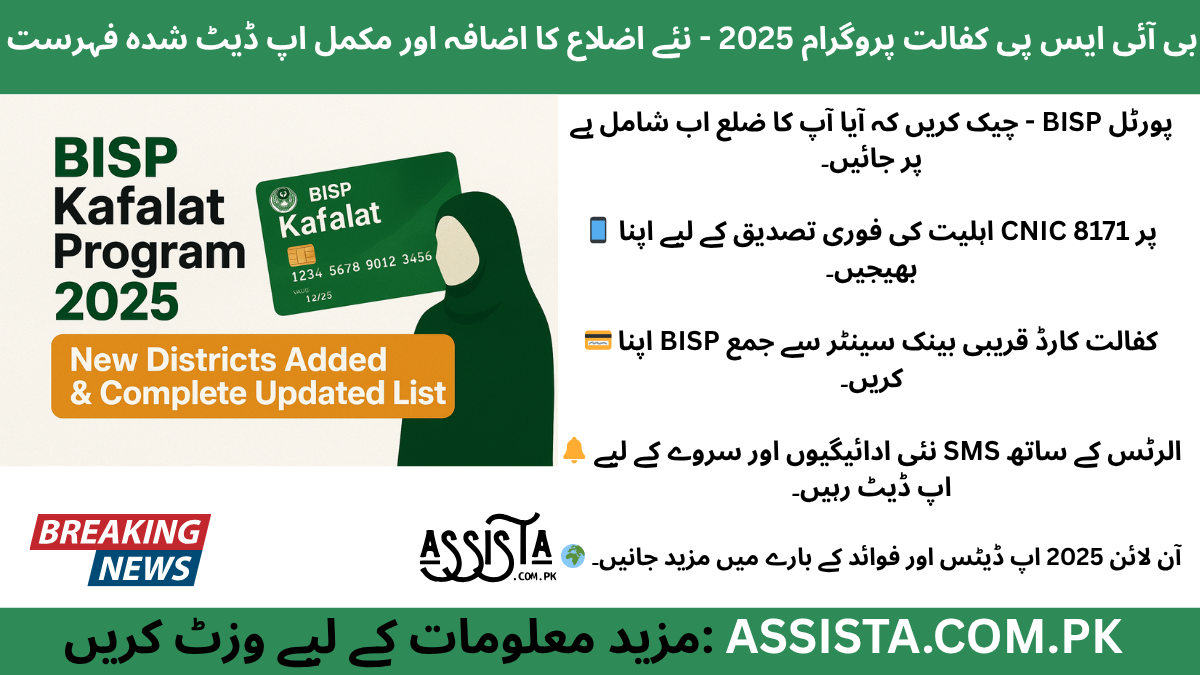
The BISP Kafalat Program 2025 is empowering families across Pakistan with new district coverage, transparent payments, and digital updates. Check eligibility now!
Introduction – What Is BISP Kafalat Program 2025?
In Pakistan, the Benazir Income Support Programme (BISP) has become a lifeline for millions of low-income families over the years. In 2025, the BISP Kafalat Program continues to play a crucial role in ensuring that families in financial need receive timely monthly cash assistance. The primary goal of the program is to provide economic relief to vulnerable households, especially those led by women, enabling them to cover basic expenses such as groceries, utility bills, and children’s education.
This year, the program has seen significant updates, most notably the addition of new districts across Pakistan. By expanding its coverage, BISP aims to reach families who were previously outside its support network, ensuring a more equitable distribution of aid. Imagine a family in a remote village of Balochistan, where access to financial resources is limited. Thanks to the 2025 updates, these families can now receive a BISP Kafalat card and enjoy direct cash assistance for the first time.
Beyond financial aid, BISP is increasingly focusing on digital integration, allowing beneficiaries to stay updated through mobile alerts, SMS notifications, and the official portal. These technological improvements ensure that payments are received promptly, and families are informed in real-time about their eligibility, payment schedules, and any required actions.
Overview of the 2025 Update
The 2025 BISP Kafalat updates are designed to make the program more inclusive, transparent, and efficient. The most prominent feature is the inclusion of new districts, particularly in regions that were previously underrepresented. This expansion means that more families than ever before can now access financial support, bridging the gap between urban and rural poverty.
Another important update is the integration of mobile alerts and online portal notifications. Beneficiaries now receive real-time updates about their payments, upcoming surveys, or verification requirements, reducing delays and confusion. For example, a mother in Sindh can now receive an SMS on her registered mobile number notifying her about the exact day her stipend will be credited to her BISP Kafalat card. This not only ensures timely payments but also builds trust between the government and the recipients.
Payment schedules have also been updated for efficiency. The program now operates on a predictable monthly cycle, enabling families to plan their expenses better. Additionally, BISP has strengthened its verification and monitoring processes, minimizing errors in beneficiary selection and reducing the risk of fraudulent claims. This 2025 update reflects a more beneficiary-centered approach, focusing on ease of access, transparency, and reliability.
Eligibility Criteria for BISP Kafalat
Eligibility for BISP Kafalat in 2025 continues to follow a needs-based approach, ensuring that aid reaches the most deserving households. The cornerstone of this selection is the Proxy Means Test (PMT) score, which assesses a family’s financial situation based on factors such as household income, assets, and living conditions. Families with lower PMT scores are prioritized, ensuring that the program serves those in genuine need.
Another key aspect of eligibility is the priority given to female heads of households. This ensures that cash assistance empowers women directly, promoting financial independence and giving them control over household expenditures. Imagine a scenario where a mother in a rural Punjab village, previously struggling to pay school fees for her children, now receives a BISP stipend that allows her to not only cover tuition but also buy essential groceries. This small but consistent support can transform lives.
To be eligible, families must also have verified CNICs and be registered on the BISP portal. Registration ensures that all data is accurate, helping the program avoid duplications and fraud. Families can check their status online, and the BISP 8171 SMS service allows beneficiaries to verify payments and district eligibility instantly. This combination of digital tools and needs-based assessment ensures that the program is both fair and efficient.
Complete Updated List of Districts
The 2025 update brings a comprehensive list of districts now covered under BISP Kafalat. While the program already included many urban and rural areas, the expansion now includes previously underserved districts in Balochistan, KP, Sindh, Punjab, and Gilgit-Baltistan. Priority has been given to regions where poverty indicators are high and access to financial services is limited.
For beneficiaries, this means that families in remote or newly-added districts can now access their Kafalat cards at authorized payment centers, including banks and ATMs. Local authorities have also been informed about the updated coverage, so families can visit Tehsil offices or district centers to verify their registration and payment schedules.
Highlighting a real-life example, in a newly-added district of KP, a family who previously had no access to formal banking now receives their stipend via a BISP 8171 Kafalat card, allowing them to purchase essentials for the household without depending on middlemen or local money lenders. This update not only increases financial inclusion but also promotes transparency and trust in the program.
The full district list, along with coverage details, is available on the BISP official portal, making it easy for beneficiaries to confirm whether their area is included. By making this information accessible and straightforward, BISP ensures that families can plan ahead and fully benefit from the program.
How to Check If Your District Is Covered
One of the most common questions among BISP beneficiaries is: “Am I eligible? Is my district covered?” Thankfully, BISP has made it easy to verify your district eligibility in 2025.
The simplest way is through the official BISP portal. By entering your CNIC number and district name, the system instantly shows whether your area is included in the program and if you are listed as a beneficiary. This step is crucial because many families miss out on payments simply due to incorrect CNIC entries or outdated registration details.
Another convenient method is the 8171 SMS service. By sending your CNIC number to 8171, you receive a confirmation message detailing your eligibility status and upcoming payment schedule. For instance, in a village in Sindh, Mrs. Saima, a mother of three, was able to confirm her eligibility without traveling to a distant Tehsil office—saving both time and money.
For those who prefer in-person verification, local Tehsil offices also provide official confirmation. Staff there can assist in checking your eligibility and guiding you through any necessary updates. The 2025 update emphasizes multiple access points so that even families in remote areas can quickly and reliably verify their coverage.
Remember, checking your district and CNIC verification regularly ensures that your stipend reaches you on time without delays.
BISP Kafalat Card & Payment Process
The BISP 8171 Kafalat card is the primary tool for receiving cash payments under the program. Once your eligibility is confirmed, the card is issued, and beneficiaries can collect monthly payments at authorized banks or ATMs.
This system ensures direct and secure disbursement, reducing the risk of fraud or third-party interference. For example, in Punjab, a family previously relied on intermediaries to access cash. With the Kafalat card, they now withdraw funds directly, giving them full control over their household finances.
Payment schedules are consistent, typically monthly, and beneficiaries receive SMS alerts on their registered mobile numbers. These notifications include the payment date, amount, and confirmation once funds are deposited. This digital integration prevents confusion and keeps families informed at all times.
Updating your mobile number on the BISP portal is also crucial. Many delays occur when beneficiaries fail to receive alerts due to outdated numbers. Once updated, SMS notifications are sent automatically for each cycle, ensuring you never miss a payment.
Moreover, beneficiaries can check payment history online through the portal. This feature allows you to confirm all previous transactions and ensure accuracy. For many families, this level of transparency builds trust in the program and encourages timely reporting of any discrepancies.
Common Mistakes & How to Avoid Them
Even with a well-structured system, new beneficiaries sometimes face challenges due to avoidable mistakes. The 2025 BISP updates provide guidance to help families avoid these common errors:
- Incorrect CNIC or District Entry: Many beneficiaries miss payments simply because their CNIC or district code is entered incorrectly. Always double-check your details on the official portal or 8171 SMS.
- Ignoring Alerts and Notifications: Failing to respond to SMS notifications, portal updates, or surveys can delay payments. Treat every alert seriously and act promptly.
- Outdated Family Data: If family members are added or removed, or if income status changes, failing to update the portal can result in errors in payment allocation. Regularly update all family information through the portal or local Tehsil office.
- Not Collecting Kafalat Card on Time: Some beneficiaries delay collecting their BISP Kafalat card. Without it, monthly cash disbursement becomes inaccessible. Collect your card as soon as you receive notification.
- Relying on Unverified Sources: Always use official channels (BISP portal, 8171 SMS, authorized banks) to check eligibility, payments, and updates. Avoid social media rumors, WhatsApp messages, or unverified agents.
Real-life example: In a newly-added district in Balochistan, a family lost two months of payments because they had not updated a deceased family member in their records. Once corrected through the portal, payments resumed immediately. Stories like these highlight the importance of accuracy, attention, and regular verification.
Alternative Ways to Verify Payments
Even though the BISP portal and SMS alerts are the primary tools for checking payments, the 2025 update introduces multiple alternative verification methods to make the process easier for all beneficiaries.
- SMS Verification via 8171: By sending your CNIC to 8171, you can instantly check your payment status and district coverage. This is particularly helpful for families in rural areas where internet access is limited.
- Mobile App for Instant Updates: BISP’s official mobile application allows beneficiaries to view monthly payment history, eligibility status, and portal notifications. It’s a convenient option for families who prefer digital verification on smartphones.
- Local Tehsil Offices: For those without access to mobile or internet, visiting the Tehsil office is a reliable alternative. Officials can confirm eligibility, payment schedules, and assist with any registration or Kafalat card issues.
A story from Sindh illustrates this perfectly: Mr. Ahmed, living in a remote village, was unsure if his family’s new district was covered. By visiting the local Tehsil office, he was able to verify eligibility, collect the Kafalat card, and ensure monthly payments started without delay. This multi-channel verification ensures no family is left behind.
Tips for New Beneficiaries
For families newly added in 2025, maximizing the benefits of BISP Kafalat requires awareness and preparation:
- Ensure CNIC and Family Info Is Accurate: Inaccuracies can delay payments. Always double-check all personal and family information on the BISP portal.
- Monitor Payment Dates and Alerts: SMS notifications and portal alerts provide exact payment dates. Tracking them helps beneficiaries plan household expenses efficiently.
- Respond to Dynamic Surveys Promptly: Occasionally, BISP conducts surveys to reassess financial status. Prompt responses ensure uninterrupted payments.
- Collect Kafalat Card Early: Avoid waiting until the last minute. Collecting the card on time guarantees smooth monthly cash disbursement.
- Leverage Local Help: If digital tools are difficult to navigate, Tehsil offices and authorized bank staff can guide you.
Consider Mrs. Saba from KP, who recently became eligible under the new district addition. By updating her CNIC and monitoring SMS alerts, she successfully received her first Kafalat payment without any hiccups. Stories like hers highlight the importance of active participation and vigilance in the program.
Final Advice – Stay Updated & Maximize Benefits
The key to getting the most from the BISP Kafalat Program 2025 is staying informed and using official channels:
- Check the Portal Regularly: Frequent visits ensure you don’t miss updates, especially regarding payments, surveys, or Kafalat card issues.
- Use Verified Channels Only: Avoid scams by relying solely on BISP portal, 8171 SMS, and authorized banks.
- Keep Payment Records: Maintain receipts, SMS confirmations, or screenshots for reference in case of discrepancies.
- Follow Updates on New Districts: Program expansion may include more areas during the year. Staying aware ensures future eligibility.
A practical tip: Many beneficiaries have missed payments simply due to outdated mobile numbers or unverified family members. Keeping all details updated is the simplest and most effective way to maximize benefits.
10 FAQs (BISP Kafalat Program 2025)
💬 Top 10 FAQs
1. What is the BISP Kafalat Program 2025?
It is a government initiative providing monthly cash assistance to low-income families, prioritizing female heads of households, now expanded to new districts in 2025.
2. Which new districts have been added in 2025?
Multiple districts in Sindh, Punjab, KP, Balochistan, and Gilgit-Baltistan are included. The full list is available on the BISP portal.
3. How can I check if my district is eligible?
Visit the BISP portal, enter your CNIC and district, or use the 8171 SMS service for instant verification.
4. Who qualifies for BISP Kafalat payments?
Eligibility is based on PMT scores, verified CNICs, and family registration. Female-headed households are given priority.
5. How do I receive my monthly payment?
Payments are delivered via BISP 8171 Kafalat card at authorized banks or ATMs, with SMS alerts for confirmation.
6. Can I update my CNIC or family data for payments?
Yes. Updates can be done through the portal or Tehsil offices to avoid payment delays.
7. How can I verify payment status online?
Through the BISP portal or by sending CNIC to 8171. Tehsil offices also provide official confirmation.
8. Are SMS alerts available for Kafalat payments?
Yes, all registered beneficiaries receive payment notifications and portal updates via SMS.
9. What mistakes should I avoid as a new beneficiary?
Avoid incorrect CNIC entries, ignoring alerts, outdated family data, and unverified sources.
10. Where can I find official BISP updates for the Kafalat program?
Updates are available on the BISP official portal, authorized bank branches, 8171 SMS service, and local Tehsil offices.
Still Confused or Need Help?
If you’re unsure about your eligibility, registration process, or want direct updates from our team — join our official WhatsApp Channel where we share all latest BISP 8171 and government scheme updates step-by-step.
Tap the button below to join our verified WhatsApp channel.
💬 Join WhatsApp ChannelStay updated — we’ll guide you until your BISP or government application process is successfully completed.
Disclaimer / اطلاع برائے عوام
English: This article has been prepared by Saleh Ashraf for public awareness regarding BISP Kafalat Program 2025 – Empowering Families with New Districts Added & Complete Updated List. It is not officially affiliated with the Benazir Income Support Programme (BISP) or any government department. For accurate verification, always use the official BISP portal or call the verified helpline 0800-26477.
Roman Urdu (اہم نوٹ): Yeh maloomat sirf public awareness ke liye hai. Is website ka BISP ya kisi hukoomati idaray se koi ta’alluq nahi hai. Apni asal tasdeeq sirf 8171.bisp.gov.pk ya BISP helpline par karein. Kisi bhi WhatsApp message, 03xx number ya fake link par apna CNIC ya personal data share na karein.
Report Fraud: Agar aapko koi suspicious call, SMS, ya fake app mile jo BISP 8171 ka dawa kare, report karein: PTA Complaint Portal, call FIA Cyber Crime (1991), ya apne qareebi BISP Tehsil Office par jaaen.
🔗 Visit Official BISP Website
Saleh Ashraf
Founder of Assista.com.pk
Hi, I’m Saleh Ashraf — a passionate blogger, researcher, and digital educator with over 7 years of experience in blogging, online awareness, and government program analysis. I started Assista.com.pk to help people across Pakistan better understand and benefit from the BISP 8171 Program and other national welfare schemes.
My goal is simple: to make sure every visitor gets clear, verified, and step-by-step guidance about registrations, payments, and updates related to government initiatives. With a strong background in research and content writing, I ensure every article published here is reliable, practical, and genuinely useful for the public.
Beyond BISP 8171, I also share updates on Ehsaas Program, utility relief schemes, and government financial support systems, empowering families to access the help they deserve with confidence and clarity.
📍 Based in Pakistan
💼 Government Awareness Blogger | BISP Program Researcher
🔔 Your trusted source for verified welfare updates and guidance across Pakistan.