Last Updated: 28 October 2025
Introduction – Why BISP 8171 Message Codes Matter in 2025
In 2025, millions of Pakistani families rely on the Benazir Income Support Programme (BISP) for their financial stability. While most beneficiaries receive messages from 8171, many struggle to understand what these SMS codes actually mean. This lack of clarity often creates confusion about eligibility, pending verification, or payment status.
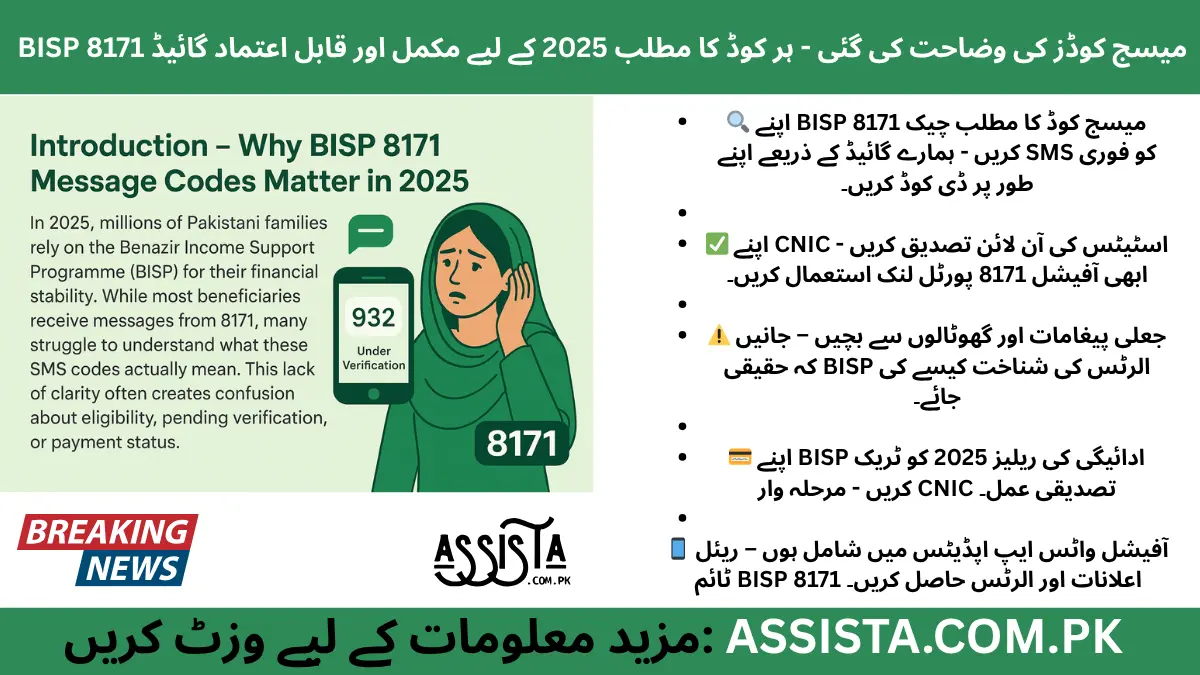
Imagine Fatima, a resident of rural Sindh. She received an SMS from 8171 saying “932 – Under Verification” and panicked, thinking she might be disqualified. Stories like hers are common: beneficiaries wait for their funds but do not fully understand the meaning behind the codes. Understanding these messages is essential because they directly impact whether a family can access their Kafalat payments on time.
The 8171 system is not just an SMS service — it is a bridge connecting BISP beneficiaries to their payments and eligibility updates. Properly interpreting the messages ensures that families can take the right steps if there is a discrepancy or delay in payment. In 2025, with system upgrades and clearer message codes, knowing what each code signifies has become even more important.
Understanding the BISP 8171 SMS Verification System
The 8171 SMS system operates as a real-time verification and notification tool for BISP beneficiaries. Managed jointly by NADRA and BISP, it sends automated messages to CNIC-registered users about eligibility, verification progress, and payment readiness.
Each message is linked to a unique code — such as 938 for eligibility or 932 for verification in process. These codes are generated after BISP cross-checks the user’s data with NADRA’s national database and the results of the dynamic survey that collects updated household information.
The process works like this: once a beneficiary is registered, the system constantly validates their CNIC, family records, and income data. If the records are complete and verified, the system sends an “Eligible” message. If there is any inconsistency or missing information, the SMS indicates “Under Verification” or “Not Eligible.”
For instance, consider Ahmed from Multan. His SMS initially showed 932 – Under Verification. After two weeks, it updated to 938 – Eligible for Payment, alerting him that he could collect his Kafalat funds at the local payment center. This shows how the 8171 system bridges the gap between verification and timely payment, making it a crucial tool for beneficiaries across Pakistan.
Types of Messages You Can Receive from 8171 (2025 Update)
Beneficiaries in 2025 primarily encounter five types of 8171 messages, each with a distinct purpose:
- Eligibility Confirmation – Codes like 938 or 123 indicate that the beneficiary is eligible for Kafalat payments. These messages often include instructions on where and when to collect the payment.
- Under Verification – Code 932 signals that the beneficiary’s CNIC and family record are being verified. During this stage, no action is required from the user except to ensure their CNIC and family data are up to date.
- Payment Ready – Newly introduced codes like 123 notify that the payment is ready for collection. This ensures beneficiaries know exactly when they can visit the payment center or receive funds digitally.
- Not Eligible / Disqualification – Codes like 999 or 404 indicate that either the beneficiary’s data does not meet the criteria or a mismatch has occurred in the records. Reasons can include expired CNICs, incomplete surveys, or outdated family records.
- Invalid CNIC / Missing Records – Occasionally, beneficiaries may receive messages if the CNIC is not found in the database. This is usually resolved after updating records with NADRA or BISP survey teams.
Take the example of Saima from Southern Punjab. She initially received 404 – Record Not Found, but after visiting her local BISP center and updating her CNIC, the system sent 932 – Under Verification, followed by 938 – Eligible, allowing her to receive her first Kafalat payment without further confusion.
BISP 8171 Message Code List (2025 Updated Table)
For clarity, here’s a concise list of the most common 8171 message codes in 2025 and their meanings:
| Code | Meaning | Action Required |
|---|---|---|
| 938 | Eligible for Kafalat payment | Collect payment at center or via approved method |
| 932 | Verification in process | Wait; ensure CNIC and family data are correct |
| 404 | Record not found | Visit BISP center to update CNIC/family info |
| 999 | Not eligible / data mismatch | Check data, update records, or reapply |
| 123 | Payment ready (new 2025 code) | Follow instructions to collect payment |
| 321 | Update CNIC / family record required | Complete the required updates immediately |
This table is a quick reference for beneficiaries. By understanding these codes, families can act swiftly — whether it’s waiting for verification, updating records, or collecting funds.
For instance, Yasir in rural Khyber Pakhtunkhwa received 321 – Update CNIC required. He visited the nearest BISP office, updated his record, and within 10 days received 938 – Eligible, demonstrating the practical impact of these codes on day-to-day life.
What “Under Verification” or “Check Back Later” Messages Mean
When a beneficiary receives a 932 – Under Verification message, it doesn’t mean they are disqualified. Instead, it indicates that BISP and NADRA are validating the user’s data. This step ensures that all CNIC details, family records, and dynamic survey information match the national database.
Take the example of Mehwish from Bahawalpur. She received a 932 message and was worried about losing her Kafalat payment. After visiting the local BISP center and confirming her family survey details, she simply waited for 10–12 days. The system then updated her status to 938 – Eligible, allowing her to collect her payment without any issues.
These messages are common and necessary because BISP needs to prevent duplicate payments, data errors, or fraudulent claims. Beneficiaries should not attempt to call multiple numbers or share CNIC details. The official protocol is to wait for the verification period and check status via the 8171 portal or official helpline.
Key Takeaways for Users:
- “Under Verification” is normal and temporary.
- Ensure your CNIC and family record are correct.
- Verification usually takes 7–15 days, depending on survey completion.
BISP 8171 ‘Eligible’ Message – What Happens Next?
Receiving an eligible message (938) is a relief for most families — it confirms that they can now access their Kafalat funds. However, understanding the next steps is critical to avoid delays.
- Check the SMS Details: The message may contain a reference code or instructions for collection. Always note the exact wording of the SMS.
- Payment Collection Options: Beneficiaries can collect funds at local BISP payment centers, or if a payment card is issued, through ATMs or bank branches.
- Verify CNIC: Make sure the CNIC number matches exactly with the BISP record; any mismatch can cause rejection at the payment center.
- Track Next Installment: Even after receiving payment, it’s important to monitor the next 8171 SMS for future installments.
Consider Aliya from rural Sindh. Her 938 message indicated eligibility for the Kafalat payment. She followed the steps, collected the money at the nearest payment center, and later received her payment card, making future transactions smoother.
Pro Tip: Save 8171 as a trusted contact and always verify payment instructions on the official BISP portal to avoid scams.
“Not Eligible” or “Record Not Found” Message – Real Reasons Behind It
Many beneficiaries panic upon receiving codes like 999 – Not Eligible or 404 – Record Not Found, but these messages often reflect fixable issues rather than permanent disqualification.
Common causes include:
- Outdated CNIC: Expired or mismatched CNICs are a frequent reason.
- Incomplete Dynamic Survey: If the household survey was partially completed, the system cannot confirm eligibility.
- Data Mismatch: Errors in the NADRA or BISP database, such as wrong family records or missing dependents.
- Migration or Internal Updates: If a family has moved or records are pending update, it may trigger 404 messages.
Take the example of Sameer from Northern Punjab. He initially received 999 – Not Eligible. After confirming that his family record was incomplete in the dynamic survey, he updated the data through the BISP portal. Within two weeks, his status changed to 932 – Under Verification, and later to 938 – Eligible.
Actionable Steps for Beneficiaries:
- Visit your nearest BISP center to verify CNIC and family data.
- Complete any pending survey updates.
- Double-check all records on the BISP portal.
- Reapply or follow up with the 8171 helpline if necessary.
This ensures that what initially seems like disqualification can often be resolved quickly with correct documentation.
How to Recheck or Confirm Your Status After Receiving Any BISP Message
Once a beneficiary receives any 8171 SMS, verifying the status through official channels is crucial. This prevents confusion and protects against fake messages.
Methods to Confirm Status:
- BISP 8171 Portal: Enter your CNIC number to see the real-time status of your message code.
- BISP Mobile App: Download the app for direct verification and updates.
- Official Helpline (8171): Call for confirmation and guidance. Do not share sensitive details with unofficial numbers or WhatsApp messages.
For example, Fariha in Gilgit-Baltistan received 932 – Under Verification. Using the 8171 portal, she checked her status and saw a note stating “Verification expected to complete within 10 days”, giving her peace of mind without unnecessary panic.
Tips for Beneficiaries:
- Check status at least twice a week during verification.
- Keep a record of previous messages for reference.
- Avoid relying on unofficial advice; always use 8171 or official BISP channels.
By following these steps, beneficiaries can stay informed, act timely, and avoid scams, ensuring their payments arrive without interruption.
Fake 8171 Messages – How to Identify Scams in 2025
Unfortunately, in 2025, scammers are becoming more sophisticated. Some attempt to exploit BISP beneficiaries by sending fake SMS messages claiming extra funds or asking for personal CNIC, bank, or card details. Recognizing these scams is crucial to protecting your money and data.
Common Scam Patterns:
- SMS from numbers other than 8171 claiming to be official.
- Messages promising instant additional payments if you click a link or share CNIC/bank details.
- Requests for one-time passwords (OTPs), which official BISP messages never ask for.
- Poor grammar, spelling errors, or unusual phrasing in the SMS.
Real-Life Example:
Sajid from Karachi received a WhatsApp message claiming he was eligible for “extra BISP bonus 2025”. The message asked him to share his CNIC and bank info. Sajid remembered the official BISP rules — no one from BISP contacts beneficiaries outside 8171 — and ignored the message. Later, he confirmed his official status via the 8171 portal, avoiding a scam.
Tips to Identify Official 8171 Messages:
- Always check the sender — official messages come only from 8171.
- Verify any message via the BISP portal or mobile app.
- Never click links from unknown sources or share CNIC/bank details.
- Save 8171 as a trusted contact on your phone.
By following these steps, beneficiaries can safely navigate SMS alerts and protect themselves from fraud, ensuring only legitimate Kafalat payments reach their accounts.
Final Tips – Save 8171 as a Trusted Contact & Check Officially Only
The last step in maximizing the benefits of BISP’s 8171 system is adopting safe practices and staying informed. Here are final, actionable tips for beneficiaries:
- Always Save 8171 as a Contact: This ensures that you can instantly recognize official messages and avoid scams.
- Verify All Codes via Official Channels: Before taking any action, check the 8171 portal or mobile app to confirm your status.
- Do Not Share Personal Information: BISP will never ask for CNIC, bank account details, or OTPs outside the 8171 system.
- Keep a Record of Past Messages: Maintaining a small log of previous codes helps track verification progress and eligibility changes.
- Update Your Records Promptly: Ensure CNIC, family survey, and household records are current to avoid delays or “Not Eligible” messages.
- Reach Out to Official Helpline if Confused: Call 8171 for clarification rather than relying on rumors or social media tips.
Example:
Rehana, a beneficiary in rural Punjab, always saved 8171 as a contact and verified her messages via the official portal. When she received 932 – Under Verification, she calmly checked the portal and confirmed that her payment would be available in 12 days. By following safe practices, she avoided scams and collected her Kafalat payment without any issues.
Key Takeaway:
Treat 8171 as your trusted lifeline. By using the system correctly, staying patient during verification, and following official channels, beneficiaries can ensure timely payments and secure access to the BISP Kafalat program.
BISP 8171 FAQs – Everything You Need to Know (2025)
BISP 8171 SMS Codes & Status FAQs 2025
Complete guide to understanding BISP SMS codes and status messages
This FAQ provides detailed information about BISP 8171 SMS codes, status messages, and how to interpret and respond to them correctly.
Code 938 indicates that you are eligible for Kafalat payment.
Once you receive this message, it means:
- Your CNIC and family records have been verified successfully by BISP and NADRA
- Your payment is ready for collection
- You can proceed to collect your payment
“Under Verification” or code 932 means your application is still being processed.
This status indicates that:
- Your CNIC, family records, and dynamic survey data are being validated
- This is a normal and temporary status
- The verification process is underway
Usually, it takes 7–15 days for the verification to complete.
“Not Eligible” (code 999) may occur due to several reasons:
- Outdated or expired CNIC
- Incomplete dynamic survey
- Data mismatch in BISP/NADRA records
- Migration or record updates pending
- Eligibility criteria not met
Yes, you can verify your eligibility, verification, or payment status using multiple official channels:
BISP Portal
8171.bisp.gov.pk
Mobile App
Official BISP application
SMS Service
Send CNIC to 8171
If you get a payment-ready SMS (like code 123 or code 938), follow these steps:
- Note the reference code from the SMS
- Visit your nearest BISP payment center or use your payment card at authorized ATMs/banks
- Verify your CNIC matches the BISP records
- Collect your payment securely
- Keep track of the next installment via the portal or app
Official 8171 SMS always have these characteristics:
- Come from 8171 only (no other numbers)
- Do not request CNIC, bank details, or OTPs
- Have proper grammar and official formatting
- Contain clear, concise information
- Never include suspicious links
No. 8171 is the official SMS sender for BISP.
Any messages from other numbers claiming to be BISP are fake and likely scams.
Typically, 7–15 days are needed for the verification process, depending on:
- Your region and local BISP office workload
- Survey completion status
- Data accuracy and completeness
Rural areas may experience slight delays due to local survey logistics.
If no SMS is received, check these potential issues:
- Ensure your CNIC is correctly registered with BISP
- Confirm your mobile number is updated in the BISP portal
- Check for network issues with your mobile provider
- Verify that your phone can receive SMS from short codes
Yes, but only after correcting the underlying issue.
Status Correction Process
Once the information is validated, your status may change from 999 – Not Eligible to 932 – Under Verification, and eventually to 938 – Eligible.
Official BISP Support Channels
- Helpline: 0800-26477
- SMS Service: Send CNIC to 8171
- Website: 8171.bisp.gov.pk
Still Confused or Need Help?
If you’re unsure about your eligibility, registration process, or want direct updates from our team — join our official WhatsApp Channel where we share all latest BISP 8171 and government scheme updates step-by-step.
Tap the button below to join our verified WhatsApp channel.
💬 Join WhatsApp ChannelStay updated — we’ll guide you until your BISP or government application process is successfully completed.
Disclaimer / اطلاع برائے عوام
English: This article has been compiled by Saleh Ashraf for educational and informational purposes regarding BISP 8171 message codes, SMS alerts, and official verification methods. It is not affiliated with the Benazir Income Support Programme (BISP) or any government department. To confirm your eligibility or message authenticity, always visit the official BISP 8171 portal or contact the verified helpline 0800-26477.
Roman Urdu (اہم وضاحت): Yeh maloomat sirf public awareness ke liye hai. Is website ka BISP ya kisi hukoomati idaray se koi ta’alluq nahi hai. Har text message jo aapko BISP ke naam se mile, uski asal tasdeeq sirf 8171.bisp.gov.pk par karein. Kisi bhi unknown SMS, WhatsApp number ya fake link par apna CNIC ya personal maloomat share na karein.
Report Fake Messages: Agar aapko koi doubtful call, SMS, ya fake message mile jo BISP 8171 ka naam use kare, foran report karein: PTA Complaint Portal, call FIA Cyber Crime (1991), ya apne BISP Tehsil Office mein inform karein.
🔗 Visit Official BISP Website
Saleh Ashraf
Founder of Assista.com.pk
Hi, I’m Saleh Ashraf — a passionate blogger, researcher, and digital educator with over 7 years of experience in blogging, online awareness, and government program analysis. I started Assista.com.pk to help people across Pakistan better understand and benefit from the BISP 8171 Program and other national welfare schemes.
My goal is simple: to make sure every visitor gets clear, verified, and step-by-step guidance about registrations, payments, and updates related to government initiatives. With a strong background in research and content writing, I ensure every article published here is reliable, practical, and genuinely useful for the public.
Beyond BISP 8171, I also share updates on Ehsaas Program, utility relief schemes, and government financial support systems, empowering families to access the help they deserve with confidence and clarity.
📍 Based in Pakistan
💼 Government Awareness Blogger | BISP Program Researcher
🔔 Your trusted source for verified welfare updates and guidance across Pakistan.